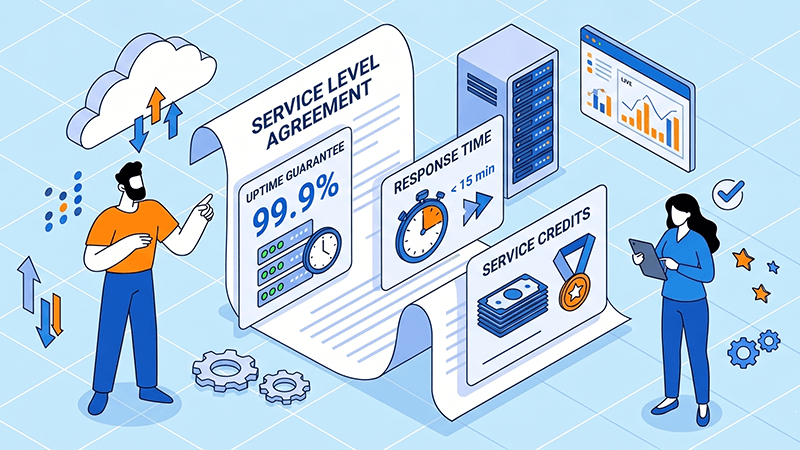
What Do SLA Metrics Actually Guarantee From Providers?
A provider can advertise strong uptime, fast support, and service credits, but that does not automatically mean your business is protected in the way you expect. The real value of SLA metrics comes down to what is actually measured, what is excluded, and what remedy applies if the provider misses the target. That is why buyers comparing hosting, cloud, or dedicated infrastructure should read the SLA as an operational document, not just a sales promise.
Why SLA metrics matter
An SLA sets the provider’s measurable commitments for service quality. It usually defines:
- uptime or availability
- response time
- resolution expectations
- performance standards
- service credits or remedies
This matters because the same headline number can mean different things depending on the provider’s definitions and exclusions.
Tip: Always read how the metric is measured, not just the percentage or promise shown on the page.
What uptime actually guarantees
Uptime guarantees usually mean the provider commits to keeping the service available for a stated percentage of time, such as 99.9%. But that does not mean zero downtime.
In most cases, you also need to check:
- what counts as downtime
- whether maintenance is excluded
- whether network or ISP issues are excluded
- whether measurement is monthly or annual
Dataplugs’ web hosting and SSD hosting SLA, for example, offers a 99.9% uptime guarantee, but also excludes scheduled and emergency maintenance, ISP issues, local circuit failure, client-side scripts, and acts of God from refund eligibility.
Tip: A 99.9% uptime SLA is only meaningful if you understand what the provider does not count.
What response time actually means
Response time is often misunderstood. It usually means how quickly the provider acknowledges a support request, not how fast the issue is fixed.
Dataplugs states 24/7 technical support with response times measured in minutes, plus a maximum response time of 4 hours for new support requests, or 6 hours outside office hours. That guarantee applies to the initial engineer response.
So in practice, response time helps you understand support accessibility, but not full restoration time.
Tip: Fast first reply is helpful, but restoration speed is what affects business continuity most.
What resolution time may cover
Some SLAs define how long it should take to resolve an issue, while others only guarantee a first response. If your service is critical, this difference matters.
A provider may respond quickly but still take much longer to restore normal service. That is why buyers should check whether the SLA includes:
- severity levels
- escalation paths
- target fix times
- workaround or restoration commitments
Without these details, “support included” can still leave too much uncertainty during an outage.
What service credits actually guarantee
Service credits are the most common SLA remedy, but they are usually limited. In many cases, they:
- apply to future invoices
- are not cash refunds
- require manual claims
- have a strict submission deadline
- are capped at a monthly maximum
Dataplugs states that service credits for SLA failure are the sole and exclusive remedy. For web hosting and SSD hosting, the credit is three times the period in excess of the guarantee, with a maximum monthly refund of 50% of the monthly subscription charge. Claims must be submitted in writing within 2 business days.
This means the SLA offers accountability, but not full compensation for business losses.
Tip: Service credits are a limited remedy, so provider reliability matters more than the refund formula.
What backup clauses really promise
Backup language is another area where assumptions can go wrong. Many customers assume backups mean guaranteed restore access. Often, that is not exactly what the SLA says.
Dataplugs explains that daily backups are performed on shared servers for disaster recovery purposes, but does not guarantee that data will always be available upon request for restore. If data is lost due to hardware failure, restoration will be attempted at no additional charge, but 100% recovery is not guaranteed.
So backups may support platform recovery, while your own business may still need a separate backup plan.
What providers usually exclude
Most SLAs are limited by exclusions. Common exclusions include:
- scheduled maintenance
- emergency maintenance
- customer misconfiguration
- third-party failures
- ISP or local network issues
- force majeure events
- indirect or consequential losses
These exclusions are often what define the real boundary of provider responsibility.
3 quick checks before choosing a provider
Check the metric definition
A good SLA explains exactly how uptime, response time, and downtime are measured.
Check the claims process
If service credits require fast manual submission, missing the deadline may mean no remedy.
Check the operational support behind the SLA
Redundant network, hardware quality, and 24/7 technical support often matter more than wording alone.
Why infrastructure still matters more than the SLA alone
An SLA is useful, but it works best when backed by solid infrastructure. Buyers should also look at:
- network redundancy
- route quality
- support availability
- hardware standards
- DDoS protection
- deployment location options
Dataplugs supports this with multiple Tier-1 ISPs, 24/7 professional support, enterprise-grade hardware, anti-DDoS options, and deployment in Hong Kong, Tokyo, and Los Angeles. Those factors help explain how service commitments are supported in real use.
Conclusion
SLA metrics tell you what a provider is willing to measure, commit to, and credit if things go wrong. They usually do not guarantee zero downtime, instant resolution, or full financial recovery. That is why the strongest buying decision comes from reading the SLA together with the provider’s infrastructure, support model, and operational track record.
If you are comparing dedicated hosting or infrastructure options and want to better understand how service guarantees apply in practice, Dataplugs is worth exploring via live chat or email at sales@dataplugs.com.