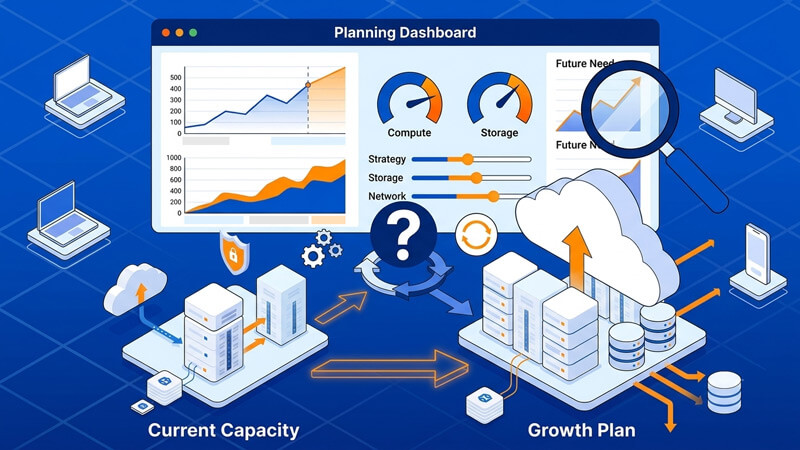
How Can Growing Online Platforms Use Capacity Planning Strategies?
Traffic issues rarely begin with a complete outage. More often, they appear as slower checkouts, delayed database activity, heavier API queues, and unstable user sessions during busy periods. For growing online platforms, these signals usually mean demand is rising faster than infrastructure decisions. Capacity planning strategies help platforms stay ahead of that pressure by improving scalability, forecasting resource needs, and reducing service risk before users feel the impact.
Why capacity planning matters for growing online platforms
Online platforms grow in uneven ways. A campaign performs better than expected, a new market starts sending traffic, or a product update increases system load across web, mobile, and API services at the same time. If capacity only gets reviewed after performance drops, teams end up reacting to technical stress instead of managing growth properly.
A better planning approach connects business activity with technical readiness. It helps teams understand whether their current server resources, network quality, storage performance, and workload design can support what is coming next. That is what makes capacity planning useful for eCommerce platforms, SaaS services, media platforms, application backends, and high-traffic websites.
It often helps with:
- steadier platform performance
- better resource allocation
- fewer emergency upgrades
- improved cost visibility
- lower risk during peak traffic
Tip: If performance becomes uneven before traffic looks extreme, capacity is already getting tighter than it should be.
What capacity planning should actually cover
Capacity planning is not only about adding more CPU or RAM. Growing platforms are affected by several connected layers, and one weak point can slow the whole service. A site may have enough compute power but still underperform because storage is slowing database activity or network routes are adding delay for users in key regions.
A useful capacity review should look at compute, memory, storage, bandwidth, routing quality, and the way workloads are separated across the application stack. It should also reflect real demand patterns such as seasonal spikes, campaign periods, launch windows, and regional traffic shifts. This matters because modern platforms usually rely on databases, APIs, background jobs, media delivery, and third-party integrations at the same time.
Capacity planning strategies platforms can use
Different platforms need different planning styles depending on budget, traffic predictability, and growth stage.
Lead strategy
This means preparing extra capacity before demand fully arrives. It works well when a platform expects stronger traffic from a planned launch, peak season, regional expansion, or marketing push. It helps protect user experience when demand forecasts are reasonably reliable.
Tip: When the cost of delay is higher than the cost of temporary spare capacity, planning earlier is usually safer.
Lag strategy
This means expanding capacity only after demand clearly increases. It is a more conservative option and often fits businesses that want tighter cost control or face less predictable growth. The downside is that the platform may spend more time under stress while waiting for a confirmed trigger.
Match strategy
This approach expands in smaller steps as traffic patterns become clearer. For many online platforms, it is the most practical method because it balances flexibility and cost discipline. It works especially well when traffic grows steadily rather than all at once.
How to forecast demand more accurately
Forecasting works better when it uses real platform behavior instead of broad assumptions. Historical traffic matters, but so do product releases, promotions, billing cycles, and regional user activity. Looking only at page views or average traffic can hide where real pressure will appear.
A stronger forecast should include concurrent users, API request growth, database transaction volume, storage growth, and bandwidth by geography. That gives teams a more realistic view of future infrastructure needs. It also helps separate temporary traffic spikes from sustained growth that requires deeper scaling.
Why bottlenecks are often outside compute
One of the most common mistakes in platform growth planning is assuming every performance issue can be fixed by adding more processing power. In reality, many slowdowns begin in storage, networking, or service design. A database-heavy platform may struggle because disk latency rises under write load. A regional platform may perform inconsistently because routing quality varies by market. A content-rich service may be limited by storage throughput rather than server CPU.
This is why capacity planning needs to cover the full delivery path, including application behavior, database activity, bandwidth, and network quality. For many growing services, performance stability depends as much on route efficiency and storage response as it does on raw server specifications.
Tip: If an application slows down under normal growth, check storage and routing before assuming the application code is the only problem.
Why dedicated infrastructure can support better planning
Cloud environments are useful, but scaling still depends on having a stable baseline. Growing platforms often benefit from predictable resources, cleaner separation between workloads, and more control over performance tuning. That is why dedicated infrastructure remains relevant for platforms moving beyond early growth stages.
Dedicated servers can make planning easier by giving teams clearer performance baselines, more reserved compute and memory, steadier storage behavior, and stronger separation between the app, cache, and database layers. This can help reduce contention and make troubleshooting more direct when traffic grows. Dataplugs offers AMD Dedicated Servers, All-Flash NVMe Servers, 1Gbps Dedicated Servers, and 10Gbps Dedicated Servers for platforms with different traffic and workload profiles. With dedicated server deployments in Hong Kong, Tokyo, and Los Angeles, supported by BGP network connectivity and multiple Tier-1 ISPs, it provides a practical base for platforms that need more predictable growth planning.
Conclusion
Growing online platforms use capacity planning strategies to make expansion more stable, predictable, and sustainable. By improving traffic forecasting, watching for early signs of strain, and planning across compute, storage, and network layers, teams can reduce service risk before problems affect users.
The goal is not simply to add more resources. It is to understand where the platform is under pressure, choose the right scaling approach, and build on infrastructure that supports long-term reliability. For businesses evaluating dedicated infrastructure for sustained platform growth, Dataplugs is one provider worth considering. With dedicated servers in Hong Kong, Tokyo, and Los Angeles, strong network connectivity, enterprise-grade hardware, and optional security services, it offers a practical foundation for online platforms planning for the next stage of demand. For more information, visit the Dataplugs website or contact the team at sales@dataplugs.com.