Database Connection Pooling for High Concurrency Applications
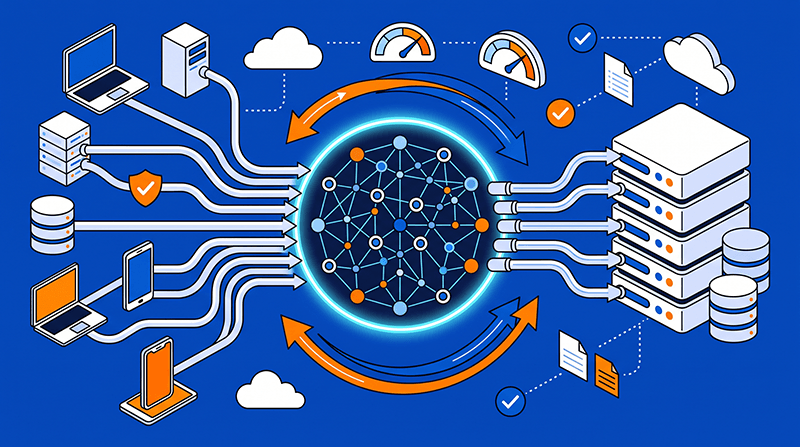
High concurrency applications can create more database connections than the database can serve comfortably. If every request opens a new connection, authentication, TLS negotiation, session setup and teardown add latency while the database spends resources tracking short-lived sessions. Database connection pooling keeps a controlled set of established connections available for reuse, so requests can borrow a connection, run work and return it without repeating the full setup cycle.
Pooling is not a substitute for query tuning or capacity planning. It is a boundary between application concurrency and database capacity. On dedicated servers, teams can align pool limits with CPU, memory, storage, network and database settings, then measure whether the pool improves response time without simply moving the queue to another layer.
How database connection pooling works
A pool creates or opens connections up to a configured limit and keeps idle connections ready. When an application needs the database, it waits for an available connection, borrows it for a transaction or session, and returns it when the work is complete. The pool validates or retires connections that are stale, broken or too old.
Connection pooling is one layer of a broader application design. Dataplugs’ Hosting Infrastructure for Real Time Collaboration Platforms explains why low latency, shared state, connection management and database capacity need to be planned together for interactive workloads.
- The application borrows an idle connection instead of opening one for every request
- A maximum pool size limits concurrent database work per application instance
- Idle, lifetime and validation rules remove stale or unhealthy connections
- Acquire timeouts expose pressure instead of allowing requests to wait indefinitely
- Transaction and session pooling preserve different levels of database state
Why high concurrency creates connection pressure
Concurrency is not the same as database capacity. A web tier may accept thousands of requests while the database can execute only a smaller number of useful queries at a time. Without a pool, a traffic spike can create a connection storm: CPU and memory are spent on connection management, schedulers switch between sessions, locks last longer and the database may reject new connections before useful work is completed.
The pool does not make unlimited concurrency safe. It queues excess borrowers in the application and gives the database a predictable connection budget. Dataplugs’ Top Backup & Disaster Recovery Tips for Dedicated Hosting also highlights the importance of defining recovery objectives, monitoring infrastructure and testing failure paths instead of relying on a single control.
- Set a per-instance pool limit that the database can actually support
- Use an acquire timeout and return a clear overload response when the pool is exhausted
- Leave reserved connections or capacity for administration, monitoring and recovery
- Account for background jobs, migrations and maintenance tasks outside the web pool
- Watch queue time as well as database query time
How to size a connection pool
Pool size should start with the database’s useful concurrency and be validated with measurements. A larger pool can increase throughput when the database has idle CPU and fast storage, but it can reduce throughput when queries compete for CPU, locks or I/O. In a multi-instance application, the total possible connections are the pool size multiplied by the number of instances, workers or processes.
Sizing should follow observed request rate, query duration, transaction time, database limits and failover needs. Dataplugs’ Optimizing Resource Allocation for Seasonal Website Traffic Spikes describes using measured CPU, memory, storage and bandwidth demand to plan dedicated infrastructure rather than sizing from averages.
- Calculate total pool capacity across every application instance
- Keep headroom below max_connections and reserve space for operators
- Measure active connections, idle connections, waiters and acquisition latency
- Test normal traffic, bursts, slow queries and partial database failures
- Increase the pool only when the database has capacity to use it
Tip: A pool that is too large often hides the real bottleneck. Compare pool wait time, query latency, CPU saturation, lock waits and storage latency before changing the limit.
Connection lifetime, idle timeouts and transaction boundaries
A pooled connection carries session state unless the pool or application resets it. Leftover search paths, roles, isolation levels, temporary tables, prepared statements or open transactions can leak behaviour between requests. The checkout and return path should reset the state that the application can change, and every transaction must commit or roll back before the connection is released.
- Connection lifetime also matters. Database failovers, firewall idle timeouts, network changes and server restarts can leave a pooled socket looking available when it is not. Use health checks, maximum lifetime, idle eviction and retry rules that discard broken connections. Do not retry a non-idempotent write blindly after an uncertain network failure.
- Return every connection after commit or rollback
- Reset session state before the next request uses the connection
- Use maximum lifetime and idle eviction to avoid stale sockets
- Validate connections after long idle periods or before sensitive work
- Make retry behaviour safe for the operation and transaction design
Session pooling versus transaction pooling
Session pooling keeps one client attached to a database connection for the duration of its session. It supports session variables, temporary tables and prepared statements, but it uses more connections when many clients remain idle. Transaction pooling returns a connection after each transaction, allowing more clients to share a smaller database connection budget, but session-specific features must not be assumed to persist.
Choose the mode according to the application framework and database features. A connection broker can improve reuse, but it also adds another failure domain and another set of metrics. Document where pooling happens, which layer owns TLS, how credentials are rotated and how a failover causes clients and brokers to discard old connections.
- Use session pooling when the application depends on session state
- Use transaction pooling when short transactions need high reuse
- Do not keep a transaction open while waiting for external APIs or user input
- Check ORM, prepared-statement and advisory-lock compatibility
- Test poolers during deploys, failovers and rolling restarts
Pool behaviour during failover and maintenance
When a database node is promoted, existing connections to the old primary may remain established but unusable for writes. The application and pool need a clear endpoint strategy, health checks and a way to drain or discard connections. A stable proxy or service endpoint can simplify routing, but it does not remove the need to coordinate promotion, fencing and application retries.
On dedicated servers, test the full event: detect the failure, stop sending new work to the old node, update the write endpoint, clear stale connections, reconnect with backoff and verify data consistency. Keep the pool from creating a reconnect storm by using bounded retries, jitter and a maximum in-flight recovery load.
- Define which endpoint is used for reads and which is used for writes
- Mark old connections unusable after promotion or network partition
- Reconnect with exponential backoff and jitter
- Limit concurrent recovery and migration work
- Record pool errors, failover time and the first successful write
Conclusion
Database connection pooling gives high concurrency applications a controlled way to reuse connections, protect database capacity and reduce setup latency. The strongest design combines a measured pool size with transaction hygiene, lifecycle rules, observability, safe failover behaviour and enough dedicated CPU, memory, storage and network headroom.
For workloads that need predictable single-tenant capacity for application servers, database systems and connection brokers, Dataplugs provides dedicated server solutions with configurable CPU, memory, storage and network options.
For more information, visit Dataplugs or contact sales@dataplugs.com.