Direct Server Return Load Balancing: When to Use It
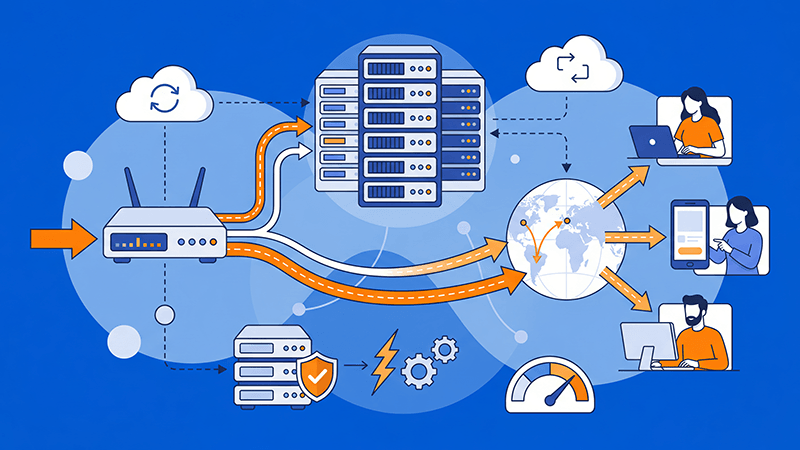
Direct Server Return (DSR) is a load-balancing design in which the load balancer receives the client request, selects a backend, and forwards the packet to that server, while the backend sends the response directly back to the client. The return path bypasses the load balancer instead of passing through it twice.
The design is most useful when response traffic is much larger than request traffic and the load-balancing tier would otherwise become a return-path bottleneck. It is not a universal replacement for a reverse proxy: DSR changes the network path, so routing, VIP ownership, health checks, firewalls, and failover must be designed together.
How Direct Server Return works
A client sends a request to a virtual IP address. The load balancer uses the VIP to receive the packet, chooses a backend, and forwards the request while preserving the destination IP in a way the backend can accept. The selected server is configured to recognise the VIP locally, often on a loopback interface, and uses its normal gateway to send the response directly to the client.
Dataplugs’ article Multi-Region Load Balancing Using Anycast, GeoIP Routing explains how a distribution layer can steer users to a region or entry point before a dedicated server performs its local return-path work. It is related to traffic steering, but it is not the same mechanism as DSR.
- Because the response does not traverse the load balancer, DSR can reduce the amount of outbound bandwidth, packet processing, and connection work required at that tier. The backend normally sees the original client source address, which can be useful for logging and policy decisions when the topology supports it.
- The trade-off is that the request and response take different paths. A stateful firewall, NAT device, intrusion-prevention system, or network policy that expects symmetric traffic may reject the return packets. The backend, VIP, ARP behaviour, and network placement therefore need explicit configuration.
- DSR is strongest when the service can make a Layer 4 decision and the response does not need to be inspected, rewritten, or logged by the load balancer.
- A health check should verify that the backend can accept the VIP and deliver the service, not merely that a process is listening on a port.
- The load balancer still owns connection selection and health state; a backend that can return packets may still be unsuitable if it has lost a required application dependency.
When DSR fits high-volume return traffic
DSR is often chosen for large static downloads, media delivery, software distribution, game patches, image delivery, and other TCP or UDP workloads where the response path carries more bytes than the request path. The load balancer handles connection selection while the dedicated backends provide the return bandwidth.
It works best when backend servers can share the VIP configuration, remain reachable through the expected gateway, and respond without requiring a proxy to terminate the application protocol. A simple L4 health check may be enough for a basic service, but a deeper application check is still needed when an open port does not prove that the service can deliver content.
- Use DSR for TCP or UDP services when the application should keep control of the protocol and the load balancer should not become the return path.
- Use DSR when retaining the client source address is important and the backend network can route the response correctly without SNAT.
- Check packets per second, concurrent flows, NIC queues, MTU, ARP behaviour, and idle timeouts; a high-bandwidth link does not by itself prove that the DSR path can handle the workload.
- DSR is not automatically stateless. Connection ownership, health state, VIP availability, backend failure, and failover timing still need an operational plan.
- If the edge must terminate TLS, apply a web application firewall, route by URL, or change the response, a Layer 7 proxy may be a better fit even if it adds return-path processing.
When a reverse proxy or NAT design is better
A reverse proxy is usually easier to operate when the edge must understand HTTP, terminate TLS, authenticate requests, apply WAF rules, add headers, enforce rate limits, or produce central request logs. In that model, both directions pass through the proxy and the proxy owns the application connection.
Dataplugs’ article How Do Network Congestion Control Algorithms Affect Server Performance? discusses how routing, path quality, retransmissions, and congestion control affect usable throughput. In a DSR design, these factors are especially important because the return path leaves the load balancer.
- Choose a proxy when several services share one address and requests must be routed by hostname, path, header, cookie, or API version. The extra processing can be worthwhile when application-aware control matters more than the maximum possible return throughput.
- Terminate TLS at the proxy when central certificate management, inspection, authentication, or policy enforcement is part of the design. DSR can still be used behind another L4 boundary, but the TLS-terminating edge is no longer a pure DSR path.
- Use SNAT or a routed backend design when servers cannot safely own the VIP or when network policy requires replies to return through the load balancer. This increases state and bandwidth at the balancer, but it may remove difficult asymmetric-routing problems.
- Collect request-level latency, status codes, upstream errors, and route-specific logs when the application needs detailed failure analysis. DSR can preserve the client IP, but it does not by itself create request visibility.
- Configure graceful draining and service-level health checks so maintenance removes only a backend that is changing or unhealthy, rather than dropping every connection that shares the VIP.
Dedicated server topology and sizing
DSR reduces work on the return path, but it does not remove the capacity requirements of the load balancer or the backend servers. Estimate new connections per second, concurrent flows, packets per second, request size, response size, TLS handshakes if any, and the amount of state held by each device.
Dataplugs’ article Automated Failover with VRRP, BGP for Server Availability explains how VRRP and BGP can coordinate endpoint ownership and route announcements. DSR still requires the VIP, backend ownership, health state, and failover path to move together.
- Measure both directions separately. The load balancer may have modest outbound traffic but still require enough CPU and packet capacity for inbound connection selection, while the backend servers may need substantial egress capacity for the actual responses.
- Confirm the required topology before deployment. Classic DSR often expects the load balancer and backends to share an appropriate Layer 2 path; routed or tunnelled variants can change the design but introduce their own MTU, encapsulation, and troubleshooting requirements.
- Tune ARP and neighbour behaviour so backend servers do not answer for the VIP from the wrong interface. Document which device owns the address, how traffic is forwarded, and how the network avoids duplicate or unstable VIP announcements.
- Decide where connection, session, cache, and queue state lives before adding more backends. DSR can distribute packets, but it cannot make an application consistent when state is local to one server.
- Provide redundant load-balancer nodes or a tested failover path, and make sure operators can see VIP ownership, backend health, ARP state, route state, and packet loss during a transition.
Validate DSR before production
Test DSR with the traffic patterns that matter: small requests, large responses, long-lived TCP sessions, UDP flows, new-connection bursts, backend failure, load-balancer failure, VIP movement, connection draining, and recovery. Confirm that clients receive the response directly and that stateful network controls do not silently discard asymmetric traffic.
Record p95 and p99 latency, packets per second, connection rate, retransmissions, dropped packets, CPU, memory, NIC counters, health-check results, and failover time. Compare the DSR design with a proxy or SNAT path using the same workload rather than assuming that bypassing the balancer will improve every metric.
Conclusion
Direct Server Return load balancing is a strong option when a dedicated-server service has high-volume responses, can operate at Layer 4, and can support asymmetric routing with clear VIP and health-state ownership. It is less suitable when the edge must terminate TLS, inspect HTTP, apply WAF rules, or provide central request-level control. The right decision comes from the protocol, traffic shape, network topology, observability, and tested failover procedure rather than from throughput claims alone.