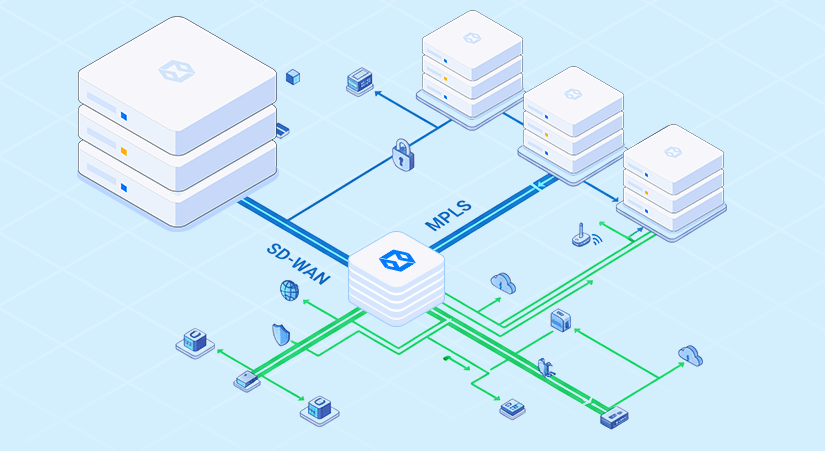
Achieving Full Path Redundancy in Hosting with MPLS, SD-WAN
Network failures and unpredictable service interruptions continue to challenge enterprise hosting environments, where even minor disruptions can trigger a chain reaction of lost revenue, diminished user trust, and compliance violations. As digital businesses increasingly depend on hybrid clouds, SaaS platforms, and distributed infrastructure, the traditional boundaries of the data center are dissolving—yet the demand for seamless, always-on connectivity has never been higher. Maintaining service availability is no longer a matter of simply adding backup links; it requires an integrated, intelligent strategy that overcomes both the technical and operational complexity of modern hosting.
The Complexity of Redundancy in a Distributed Hosting Landscape
Legacy approaches to redundancy, such as static routing and simple failover protocols, are ill-equipped to address today’s multi-path, multi-cloud environments. These methods rely on manual intervention and fixed configurations, creating bottlenecks when traffic patterns shift or infrastructure evolves. Modern enterprises must contend with diverse connectivity options—ranging from dedicated private links to broadband internet and wireless networks—each with unique performance, security, and cost implications. The challenge is to orchestrate these disparate resources into a cohesive, resilient network fabric that delivers true hosting path redundancy.
MPLS: The Backbone of Reliable Enterprise Connectivity
Multiprotocol Label Switching (MPLS) has long been the standard for organizations requiring deterministic performance and reliability. By assigning labels to packets and directing them along pre-defined, private routes, MPLS ensures predictable latency and service levels for mission-critical applications. This makes it a preferred option for sectors such as finance, healthcare, and government, where quality of service (QoS) and uptime assurances are paramount.
MPLS circuits are isolated from the public internet, providing an additional layer of security and eliminating many of the variable risks associated with shared infrastructure. However, the trade-offs are significant: MPLS is costly, slow to provision, and inflexible in the face of dynamic business needs. Scaling to new locations or adapting to rapid growth can take months and require hard-to-justify capital expenditure, particularly in regions with limited carrier presence.
SD-WAN: Intelligent Path Selection and Dynamic Failover
Software-Defined Wide Area Networking (SD-WAN) transforms the WAN by decoupling network management from physical circuits. Operating as a software overlay, SD-WAN can aggregate and optimize traffic across multiple underlays, including MPLS, broadband, 4G/5G, and direct cloud connections. This flexibility enables enterprises to leverage the performance of MPLS where required, while using cost-effective broadband or wireless links to scale bandwidth and reach.
A core capability of SD-WAN is real-time path monitoring and dynamic traffic steering. The system continuously evaluates link health—measuring latency, jitter, and packet loss—and automatically routes traffic over the optimal path, minimizing downtime and maximizing application performance. In a hosting context, this means that if an MPLS circuit degrades or fails, SD-WAN can instantly reroute sessions via alternative links, maintaining seamless service delivery to users and applications.
Architectural Strategies for Full Path Redundancy
Achieving full path redundancy involves more than connecting multiple links; it requires a holistic approach to network design, monitoring, and policy enforcement. The most resilient hosting environments implement a hybrid model, combining geographically diverse MPLS and internet circuits with SD-WAN overlays to deliver granular, application-aware failover.
Advanced network architectures leverage multi-path BGP routing and direct interconnects with Tier-1 ISPs, as seen in Dataplugs’ infrastructure. This not only optimizes routing efficiency and reduces latency, but also mitigates the risk of single points of failure at both the network edge and core. Network segments are protected with redundant hardware, power supplies, and upstream providers, ensuring that physical and logical events—ranging from cable cuts to DDoS attacks—can be absorbed without impacting hosted services.
Operationalizing Redundancy: Visibility, Compliance, and Automation
Maintaining operational control over a redundant hosting network requires deep, real-time visibility into traffic flows, link status, and application performance. Legacy monitoring tools focus on Layer 3 and 4 statistics, but modern environments demand insight into Layer 7 (application-level) traffic, which is essential for diagnosing issues rooted in API calls, session management, or encrypted payloads.
Comprehensive monitoring platforms integrate with SD-WAN controllers and MPLS management systems to provide unified views of network health. They generate actionable alerts when failover occurs, validate that redundant paths are functioning correctly, and support compliance with regulatory mandates such as GDPR, HIPAA, and PCI DSS by logging all routing and security events.
Automation is a critical enabler at this stage. Policy-based orchestration ensures that security postures—such as firewalls, segmentation, and DDoS protection—are consistently enforced across all paths, even as the network dynamically adjusts to failures or congestion. Without this automation, organizations risk misaligned access controls and compliance gaps during failover events.
Cost Efficiency and Business Agility in Redundant Architectures
While MPLS delivers unmatched reliability, its cost and rigidity make it unsustainable as a sole solution for most enterprises. SD-WAN introduces a new paradigm of cost efficiency, allowing organizations to blend premium MPLS with more affordable internet links, scaling bandwidth where needed without incurring prohibitive expenses.
This hybrid approach not only reduces operational costs, but also enhances business agility. Enterprises can quickly connect new branches, integrate cloud services, or respond to shifting user demands—confident that their hosting platform remains resilient regardless of underlying network changes. Dataplugs’ ability to rapidly provision dedicated servers and network services supports this agility, giving clients the power to adapt as their environments evolve.
Data Privacy, Security, and Compliance in Redundant Hosting
As organizations route sensitive data across multiple network paths, maintaining privacy and compliance becomes increasingly complex. MPLS offers inherent isolation, but SD-WAN deployments must implement robust encryption, access controls, and audit trails to secure traffic traversing public networks. Modern SD-WAN solutions integrate with security frameworks such as Secure Access Service Edge (SASE), embedding next-generation firewall, intrusion prevention, and data loss prevention directly into the network fabric.
At Dataplugs, redundant hosting architectures are fortified by enterprise-grade security measures: DDoS mitigation, web application firewalls, and continuous monitoring ensure that compliance obligations are met—without sacrificing performance or availability.
How Dataplugs Supports Full Path Redundancy
Dataplugs delivers an infrastructure foundation built for high-availability and operational resilience. With multi-path BGP networking, direct connections to Tier-1 ISPs, and data centers located in Hong Kong, Tokyo, and Los Angeles, Dataplugs enables clients to achieve true hosting path redundancy that meets both regional and global requirements. The company’s dedicated server solutions are designed for rapid provisioning and support a range of workloads—from high-throughput monitoring to mission-critical application hosting. Combined with 24/7 technical support, robust DDoS protection, and proactive monitoring, Dataplugs provides the expertise and infrastructure needed to implement effective redundancy strategies without compromising on security or compliance.
Conclusion
Enterprises navigating the challenges of today’s distributed digital environments must move beyond traditional notions of redundancy to adopt intelligent, adaptive solutions that combine MPLS and SD-WAN. The result is a resilient, future-ready hosting platform that minimizes downtime, optimizes performance, and supports growth in an evolving landscape. For organizations ready to operationalize full path redundancy and safeguard business continuity, Dataplugs stands as a partner with proven infrastructure and deep technical expertise. To explore hosting path redundancy architectures and custom solutions, reach out via live chat or email sales@dataplugs.com.