Dedicated Server Requirements for Running Open Source AI Agent Workloads
An open source AI agent can perform well in testing, then start behaving unpredictably once it is left running continuously. In most cases, the weakness is not the framework itself. It is the server underneath it struggling to keep up with retrieval, browser activity, memory, logs, queue workers, API calls, and background processing all at once. That is why dedicated server requirements matter so much for production AI use. The question is not simply whether the agent can run. The real issue is whether the environment can stay stable, responsive, and manageable once the workload becomes constant.
Why open source AI agent workloads need more than basic hosting
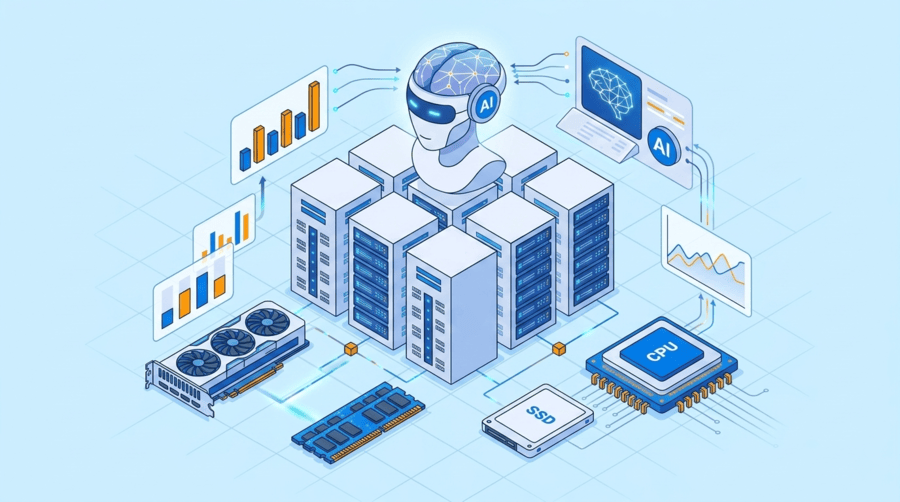
Open source AI agent workloads usually involve much more than just model access. A typical deployment may include orchestration logic, external or local LLM inference, vector search, persistent storage, browser automation, webhooks, task queues, monitoring, and access control. Even if each part works on its own, the full stack puts steady pressure on CPU, RAM, storage, and network quality. This is where many teams discover that a server that looked fine during setup is no longer enough once real usage begins.
A dedicated server is often the better fit because it gives the workload room to operate without competing with shared tenants. That matters more with AI agents than with many standard applications, because agents often run around the clock and rely on multiple services at the same time. A dedicated server for AI workloads gives you more predictable CPU availability, cleaner memory usage, better storage control, and a more controlled security boundary. For businesses moving from testing to production, that usually makes the whole environment easier to trust.
CPU, RAM, and storage are usually the first real requirements
The first place to size properly is not always the GPU. In many cases, CPU, RAM, and storage matter first. AI agents depend on CPU resources for orchestration, browser actions, queue handling, retrieval, and system coordination. A modern 8-core or 16-core processor can be enough for smaller environments, but once the deployment includes multiple agents, heavier automation, or higher concurrency, a more capable CPU becomes important. Stability matters more than headline core count alone. The server needs enough compute to keep response times even when several services are active together.
Memory is often the real limit in practice. An agent may seem fine during light testing, then slow down badly once the vector database, browser sessions, logs, and background services are all active. For many real-world deployments, 32GB RAM is the minimum that starts to feel practical. If the environment includes multiple services or heavier retrieval use, 64GB creates a much healthier margin. When RAM is too tight, the server begins relying on swap, and the agent starts feeling unreliable even if it never fully crashes.
Storage speed matters just as much. AI systems constantly read and write data, from embeddings and caches to session state and logs. Slow disks create friction across the entire stack. NVMe storage is the sensible standard for this kind of environment. A 1TB NVMe drive is a reasonable entry point, while 2TB or more is usually more comfortable for production systems that are keeping vector data, persistent memory, and historical logs. Many buyers underestimate how much storage performance affects the real experience of running AI workloads.
Tip: If the setup includes retrieval, browser automation, and persistent logs, storage quality will often have a bigger impact than buyers expect.
When a GPU matters and when it does not
A GPU server is not automatically required. That point is often overlooked because AI infrastructure is frequently discussed as if every serious deployment must begin with GPU hardware. In reality, many AI agent server hosting setups rely on commercial APIs for model inference, while the server itself handles orchestration, retrieval, memory, and workflow logic. In those cases, a strong dedicated CPU server with enough RAM and fast NVMe storage can be the right starting point.
A GPU becomes much more relevant when the plan is to run self-hosted open-source language models locally, use multimodal models, or keep sensitive inference fully inside your own environment. The better approach is to size the server based on the actual architecture rather than buying GPU capacity simply because the project involves AI.
Note: Do not assume that every open source AI stack needs GPU hardware on day one. Match the server to the workload, not the label.
Security and runtime control cannot be treated as secondary
Once an AI agent can access files, trigger workflows, call APIs, or interact with browsers, the server becomes part of the security model. A dedicated machine is useful here not just for performance, but because it gives you a cleaner environment to control. That matters when the deployment includes business data, internal tools, customer information, or persistent credentials.
A good AI agent environment should be treated as a controlled runtime rather than a general-purpose machine. In practice, that means thinking early about backup policy, access control, network exposure, user separation, and how logs or sensitive files are handled. Open source AI agents can be flexible, but that flexibility cuts both ways if the environment is not planned carefully.
Tip: Treat the server as a production runtime for the agent, not as a spare box where unrelated apps and files also live.
Network quality affects how reliable the agent feels
Network quality has a direct effect on whether an AI agent feels dependable. Even when model inference is external, the system still depends on consistent routes for APIs, dashboards, browser sessions, and user-facing activity. A poorly routed server can make the whole setup feel laggy or inconsistent. This matters especially for teams serving users across Asia.
Dataplugs is particularly relevant here because its dedicated server infrastructure is built around Hong Kong with strong connectivity across the region, including options suited to workloads that depend on stable international routes and better China access. For businesses operating in Hong Kong, Mainland China, or wider Asia, that network profile can be just as important as the hardware itself.
Tip: If your AI agent interacts with users or systems across Asia, ask about route quality before choosing a server location. Good hardware on a weak route still feels slow.
What to check before buying a dedicated server
Before choosing a dedicated server, it helps to check a few practical things early. The most important questions are whether the server is truly dedicated, whether the memory and storage are sized for the full stack rather than just the model layer, whether the network is suitable for your region, and whether backup and security options are in place from the start. Full root access, remote management, and a sensible upgrade path also matter because AI workloads tend to grow once the agent proves useful.
This is one reason Dataplugs fits well into this conversation. Its dedicated hosting options, enterprise-grade network infrastructure, and practical add-ons such as DDoS protection and scalable server tiers make it a relevant option for businesses that want a stable base for AI deployment without turning the infrastructure into the whole project.
A practical starting point for most deployments
For many production open source AI agent workloads, a sensible starting point is a modern enterprise CPU, 32GB to 64GB of RAM, and 1TB to 2TB of NVMe storage on a properly routed dedicated server. That is usually enough for orchestration, retrieval, browser-based tasks, and continuous operation without overspending too early. If the workload later shifts toward local inference or heavier private AI use, the infrastructure can then be expanded more deliberately.
Tip: Buy for the workload you expect after real adoption begins, not just for the first clean demo.
Conclusion
The best dedicated server requirements are rarely about choosing the biggest machine available. They are about choosing a server that can keep the full agent environment stable once it starts doing real work. For open source AI agent workloads, that usually means enough CPU for orchestration, enough RAM for the connected services, fast storage for active data, and network quality that matches where your users and systems actually are. A dedicated server becomes the practical choice when reliability, control, and long-run consistency matter more than getting the cheapest possible environment.
To learn more about Dataplugs dedicated server hosting, contact the team via live chat or email at sales@dataplugs.com.