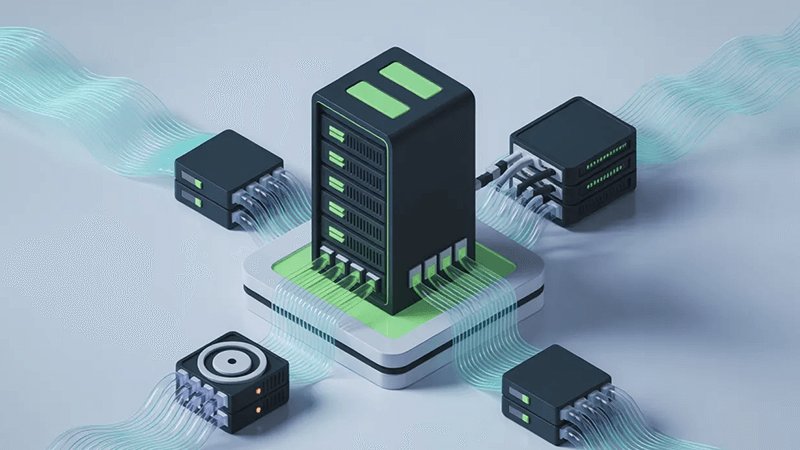
Enabling High-Performance iSCSI, Fibre Channel in Data Centers
As data centers evolve to support a wide spectrum of workloads—ranging from latency-sensitive databases to elastic cloud applications—teams must address mounting storage complexity. Traditional approaches often fall short when performance dips unpredictably during virtualization spikes or when backup and replication traffic disrupts operational continuity. The challenge is to architect storage connectivity that sustains speed, reliability, and scalability, all while accommodating increasing demands for resilience and agility in hybrid and multi-cloud environments.
Fibre Channel and iSCSI: Roles in the Modern SAN
Fibre Channel (FC) and iSCSI remain the backbone of enterprise block storage, but their suitability depends on nuanced use cases. Fibre Channel, a purpose-built, lossless protocol, is engineered to deliver high throughput and ultra-low, predictable latency over dedicated fabrics. This isolation from general traffic makes FC ideal for mission-critical workloads and industries where data integrity and uptime are non-negotiable. Modern FC networks operate at 16G, 32G, 64G and beyond, leveraging zoning, multipathing, and advanced QoS to ensure consistent performance even under heavy loads.
iSCSI, by contrast, offers flexibility and cost efficiency by using IP over standard Ethernet infrastructure. Recent advancements in 25G, 40G, and 100G Ethernet, along with TCP Offload Engine (TOE) support, have closed the performance gap, making iSCSI a practical option for virtualized data centers, hybrid cloud integration, and organizations seeking rapid scaling without dedicated hardware. Its routability and compatibility with existing network infrastructure allow for seamless extension across geographies and workloads.
Performance and Reliability: Practical Considerations
In real-world deployments, performance bottlenecks are influenced by more than protocol choice—they’re shaped by fabric design, oversubscription rates, storage media (SSD, NVMe), and controller architecture. FC remains marginally superior for IOPS and latency due to its hardware-driven, Layer 2 switching and minimal protocol overhead. However, iSCSI, when implemented with non-blocking switches and optimized for jumbo frames, can achieve throughput and reliability approaching FC, especially in well-segmented networks.
Designing a High-Performance SAN: Best Practices
- Redundancy and Multipathing: Both FC and iSCSI should implement dual fabrics, redundant controllers, and multipath I/O to eliminate single points of failure and support live migration or failover.
- End-to-End Quality of Service: Prioritize mission-critical applications by configuring protocol-level QoS, VLANs, and zoning to prevent contention and guarantee bandwidth.
- Monitoring and Analytics: Granular performance metrics, real-time anomaly detection, and capacity planning are vital for proactive management. Modern platforms integrate AI-driven analytics to optimize SAN health and preempt congestion or errors.
- NVMe over Fabrics (NVMe-oF): Both FC and Ethernet-based protocols now support NVMe-oF, which dramatically reduces storage stack latency and unlocks the full performance of all-flash arrays.
- Security and Segmentation: Enforce strict zoning, network segmentation, and encryption to protect sensitive data and ensure compliance with industry mandates.
Cost, Manageability, and Scalability
FC’s specialized hardware and operational complexity result in higher initial and ongoing costs, but its deterministic performance justifies the investment for regulated or high-stakes environments. iSCSI, leveraging commodity hardware and familiar TCP/IP management, delivers lower total cost of ownership and is easier to automate and integrate with DevOps pipelines or software-defined storage.
A hybrid strategy—deploying FC for core, high-throughput workloads and iSCSI for distributed or less critical tasks—lets organizations balance performance, budget, and future growth.
Automation and Lifecycle Management
- Provisioning and Orchestration: Automated tools streamline LUN allocation, zoning, and network configuration, reducing manual error and accelerating deployment.
- Regular DR Drills: Proactive disaster recovery testing ensures that failover and restore procedures work as intended, minimizing business impact during incidents.
- Lifecycle and Compliance: Ongoing firmware updates, compatibility checks, and regulatory reporting keep the SAN optimized and secure.
Dataplugs: SAN Storage Solutions for Modern Data Centers
Dataplugs offers enterprise-class SAN solutions tailored for dynamic, high-demand environments. Their storage architecture harnesses both Fibre Channel and iSCSI protocols to provide secure, scalable, and centralized storage access.
- Private, high-speed network interconnects for shared storage pools
- Supports both Fibre Channel (for ultra-low latency and lossless transport) and iSCSI (for flexible, Ethernet-based connectivity)
- Centralized data management for streamlined backups and simplified disaster recovery
- Mirroring and snapshots for enhanced data security and quick restore points
- Scalability to independently expand CPU and storage as business needs change
Dell EMC SC7020F All-Flash SAN and Service Features
Dataplugs’ deployment of the Dell EMC SC7020F All-Flash Storage Array supports businesses as they scale, ensuring high throughput and robust data protection.
- Up to 1.2 million IOPS and support for both Fibre Channel and iSCSI protocols
- Dual Intel Xeon processors and 256GB RAM for fast, reliable performance
- Advanced management interfaces (browser-based and cloud analytics)
- Federated scalability, live migration, and multi-array federation
- Intelligent deduplication, compression, and RAID tiering for storage optimization
- Redundant power, active-active controllers, and guaranteed Quality of Service (QoS)
- Thin snapshots, replication, and built-in application recovery tools
Dataplugs guides clients through protocol selection, RAID configuration, and ongoing support, ensuring SAN deployments are optimized for both present and future requirements.
How Dataplugs Can Support Your Data Center Transformation
Dataplugs is positioned to help organizations address the real-world challenges of modern data center storage connectivity. By combining expert consultation with robust infrastructure, Dataplugs delivers:
- Tailored solutions based on workload analysis and business objectives
- Expert guidance in protocol selection (Fibre Channel vs. iSCSI) and hybrid deployments
- Rapid deployment with customizable hardware and connectivity options
- Ongoing monitoring, migration support, and 24/7 technical assistance
- Secure, compliant hosting environments across Hong Kong, Tokyo, and Los Angeles
This comprehensive approach allows businesses to deploy, scale, and optimize high-performance SAN architectures with confidence, ensuring uninterrupted operations and future-ready infrastructure.
Conclusion
Enabling high-performance iSCSI and Fibre Channel in data centers is about more than protocol—it’s about aligning infrastructure, operational practices, and automation for seamless, resilient storage connectivity. As workloads diversify and expectations intensify, organizations that integrate robust SAN design, proactive monitoring, and flexible infrastructure will be best positioned to deliver uninterrupted, scalable digital services. For expert guidance and solutions tailored to enterprise storage challenges, connect with Dataplugs via live chat or email sales@dataplugs.com.