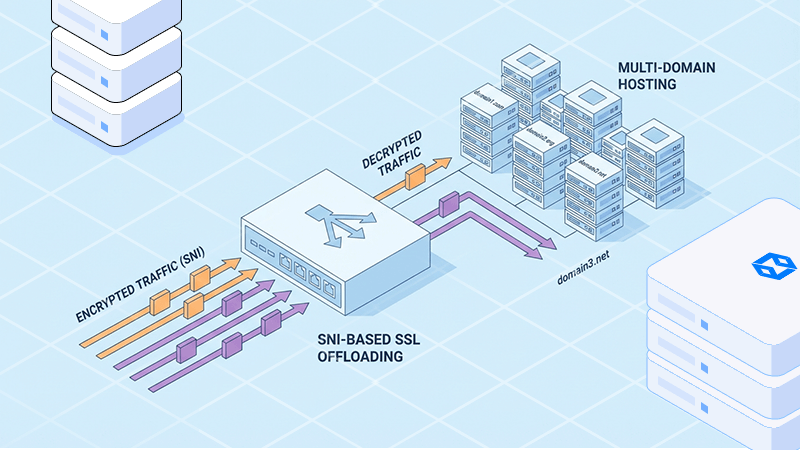
Implementing SNI-Based SSL Offloading for Multi-Domain Hosting
When dozens of HTTPS domains converge onto shared infrastructure, SSL stops being a background concern and starts shaping system behavior. TLS handshakes compete for CPU time, certificate renewals fragment across environments, and IP address constraints quietly limit growth. In multi-domain hosting setups, these pressures surface long before anything actually breaks. SNI based SSL offloading emerged as the architectural response to this reality, allowing encrypted traffic to scale without multiplying complexity.
This article goes deep into how Server Name Indication SSL offloading works, why it underpins modern multi domain SSL offloading strategies, and how to design an SNI SSL configuration that remains stable as traffic, domains, and compliance requirements grow.
Why Multi-Domain Hosting Forces a Rethink of SSL Design
Multi-domain hosting today spans far beyond traditional shared hosting. It includes:
- SaaS platforms serving many customer domains
- Reseller and agency hosting environments
- VPS and cloud deployments with staging and production sites
- Regional or multi-site application architectures
Each domain still requires its own HTTPS identity, but older SSL models assumed a one certificate, one IP relationship. That assumption no longer holds.
Traditional SSL deployment introduced structural limits:
- IPv4 exhaustion due to dedicated IP requirements
- Higher operational cost for IP management
- Rigid coupling between DNS and certificate changes
- Difficult scaling when new domains are added
SSL offloading multi domain hosting removes these constraints by separating encryption and certificate selection from IP addressing.
How Server Name Indication Works Inside the TLS Handshake
Server Name Indication is a TLS extension that allows the client to send the requested hostname as part of the initial handshake, before encryption is finalized.
With SNI in place:
- The browser includes the domain name during the TLS handshake
- The server or load balancer selects the matching SSL certificate
- Multiple certificates coexist on the same IP address
- Each domain remains cryptographically isolated
Without SNI, a server cannot determine which certificate to present when multiple domains share an IP. With SNI, certificate selection becomes deterministic and scalable.
This mechanism is now foundational across modern browsers, operating systems, and enterprise networking stacks.
What SSL Offloading Adds to the SNI Model
SNI solves certificate selection. SSL offloading solves performance and operational efficiency.
In an SSL offloading architecture:
- TLS termination happens at a load balancer, proxy, or edge layer
- Backend application servers receive decrypted traffic
- Certificate policies are enforced centrally
This design delivers measurable benefits:
- Reduced CPU load on application servers
- Faster response times under concurrent traffic
- Centralized control of TLS versions and ciphers
- Cleaner separation between security and application logic
When combined, SNI based SSL offloading becomes the standard model for hosting multiple HTTPS domains at scale.
Certificate Management in Multi-Domain SSL Offloading
Certificate lifecycle management is one of the most error-prone aspects of HTTPS operations. Expired or misconfigured certificates remain a common cause of outages.
SNI based designs typically favor per-domain certificates rather than bundled SAN certificates. This approach provides:
- Independent renewal cycles for each domain
- Smaller blast radius if a certificate expires or is revoked
- Better alignment with ACME automation such as Let’s Encrypt
- Easier onboarding and removal of domains
SAN certificates still serve specific use cases, but in dynamic hosting environments, SNI based multi domain SSL offloading offers superior flexibility and operational clarity.
Security Characteristics of SNI SSL Configuration
From a security perspective, SNI does not weaken encryption. Each domain maintains its own private key and certificate.
Key security properties include:
- Cryptographic isolation between hosted domains
- Central enforcement of TLS 1.2 and TLS 1.3 policies
- Unified visibility into certificate status and expiration
- Reduced configuration drift across servers
Because TLS termination occurs before traffic reaches the application, application logic should rely on headers such as X-Forwarded-Proto to correctly interpret HTTPS requests.
Infrastructure Stability and SSL Offloading Reliability
TLS handshakes are sensitive to infrastructure quality. CPU contention, network jitter, and inconsistent IO performance can all degrade handshake latency and user experience.
Reliable SSL offloading environments require:
- Predictable CPU and memory allocation
- Low latency, high throughput network paths
- Stable routing without packet loss
- Full control over proxy and TLS configuration
Oversubscribed platforms can introduce subtle delays that only appear under load, making infrastructure choice a critical factor in SSL reliability.
Why Dedicated Servers Matter for SNI Based SSL Offloading
As traffic and domain count grow, the limitations of shared environments become more pronounced. SSL offloading layers must process large volumes of TLS handshakes consistently, without interference from unrelated workloads.
Dedicated servers provide:
- Exclusive CPU and memory resources
- Predictable performance under sustained HTTPS traffic
- Full administrative control over SSL and proxy stacks
- Stable network throughput for handshake-intensive workloads
Dataplugs Dedicated Server solutions align naturally with SNI based SSL offloading architectures. By offering high-bandwidth connectivity, low-latency routing, and isolated resources, Dataplugs enables SSL termination layers to operate without contention. This ensures that certificate negotiation, renewal automation, and encrypted traffic handling remain stable as domain portfolios expand.
For hosting providers, SaaS platforms, and enterprises managing multiple HTTPS domains, dedicated infrastructure forms a reliable foundation for long-term SSL operations.
Conclusion
SNI based SSL offloading addresses the structural challenges of multi domain hosting: IP scarcity, certificate sprawl, performance overhead, and operational risk. By decoupling certificate selection from IP addresses and moving TLS workloads to the edge, organizations gain scalability without sacrificing security.
As HTTPS becomes universal and hosting environments continue to consolidate, SNI based architectures are no longer optional. When paired with stable, high-performance infrastructure, they become an invisible yet essential layer of modern hosting.
For teams designing or refining multi domain SSL offloading strategies, Dataplugs provides the dedicated infrastructure required to support SNI SSL configurations reliably at scale. For further details, Dataplugs can be reached via live chat or email at sales@dataplugs.com.