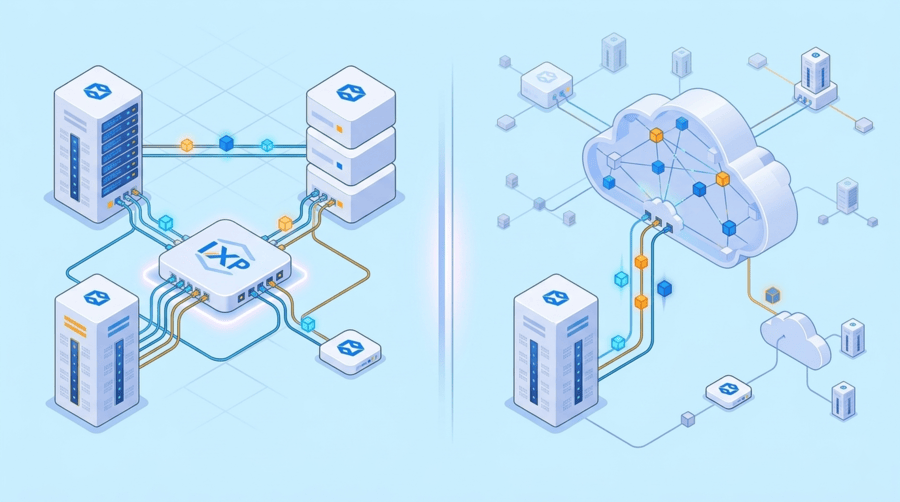
What Is the Difference Between IX Peering and Transit Providers?
When your dedicated server performs well locally but slows down for users in other regions, the issue is rarely hardware. It comes down to how traffic leaves your server and travels across networks. Once requests move beyond a single region, routing paths become longer, less direct, and far less predictable. That is where the difference between IX peering and transit providers starts to matter.
For businesses running dedicated servers, this directly affects latency, stability, and how consistent your service feels across different countries.
Understanding the Basics of Internet Connectivity
Every dedicated server connects to the internet through an Autonomous System (AS). These systems exchange traffic using BGP, forming the global routing structure behind everything online.
There are two primary ways your server reaches other networks:
- through transit providers
- through internet exchange IX using peering
Transit gives you full reach. Peering improves how efficiently traffic moves between key networks.
Tip: When selecting a dedicated server, always look beyond bandwidth specs and ask how the network is connected upstream.
IP Transit: The Foundation of Global Reach
IP transit is the standard way most dedicated servers connect to the internet. Your provider links your server to upstream carriers, allowing it to reach any destination worldwide.
Advantages of IP Transit:
- full internet access without complex setup
- simple and reliable baseline connectivity
- supported by large carrier infrastructure
Disadvantages of IP Transit:
- traffic may take indirect routes
- higher latency for certain regions
- limited control over routing paths
For dedicated server users, transit ensures accessibility, but not always efficiency.
IP Peering: Improving Routing Efficiency
IP peering allows networks to exchange traffic directly, either privately or through an internet exchange IX. Instead of relying on upstream carriers, traffic flows through shorter and more optimized paths.
Advantages of IP Peering:
- lower latency due to fewer network hops
- improved speed for high traffic destinations
- more consistent performance
Disadvantages of IP Peering:
- limited to specific connected networks
- requires strong interconnection ecosystems
- does not replace transit بالكامل
For dedicated servers, peering is what improves real world performance, especially for users in specific regions.
Tip: If your audience is concentrated in Asia or the US, choose a server provider with strong peering in those regions.
IP Transit vs Peering: What It Means for Your Server
Looking at IP transit vs peering from a performance perspective:
With transit:
traffic may pass through multiple networks
routing depends on upstream providers
performance can vary by region
With peering:
traffic takes more direct paths
fewer hops reduce delay
performance is more predictable
This difference becomes noticeable in applications where speed matters, such as eCommerce platforms, SaaS tools, and streaming services.
BGP Peering vs Transit: Control Behind the Network
At the routing level, BGP peering vs transit determines how traffic decisions are made.
Transit relies on provider controlled routing. Your server follows predefined paths with limited flexibility.
Peering allows more control:
- optimizing routes for important networks
- reducing unnecessary detours
- improving consistency during peak traffic
For businesses, this translates into better user experience without needing to change server hardware.
Why Network Location Still Matters
Server location is not just about proximity. It is about connectivity.
Major hubs like Hong Kong, Tokyo, and Los Angeles provide better performance because they offer:
- dense IX ecosystems
- multiple carrier connections
- strong international bandwidth
Dataplugs places dedicated servers in these key locations, allowing traffic to benefit from better routing paths and stronger interconnection environments.
Tip: A well connected server in a major network hub often performs better than a closer server with weaker connectivity.
Cost vs Performance in Real Deployment
While users do not directly manage transit or peering costs, it affects the overall value of your server.
Transit heavy networks are easier to deploy but may lead to inconsistent performance across regions.
Peering rich environments improve efficiency, especially for high traffic routes, and deliver more stable user experiences.
This is why many modern infrastructures move toward a hybrid approach instead of relying on just one.
Building an Optimized Dedicated Server Setup
The most effective setup combines both models:
- IP transit ensures full global reach
- IX peering optimizes high traffic routes
- multiple carriers improve redundancy
- strategic server placement reduces latency
Dataplugs supports this approach through carrier neutral infrastructure and strong connectivity in global network hubs, allowing businesses to balance reach and performance without overcomplicating deployment.
Conclusion
The difference between IX peering and transit providers is not just technical. It directly affects how your dedicated server performs across regions. Transit ensures your server can reach everywhere, while peering ensures it reaches key destinations efficiently.
For businesses serving international users, combining both is the most practical approach to achieving stable, low latency performance.
If you are planning to improve your global server performance or evaluate better hosting infrastructure, you can connect with the Dataplugs team via live chat or at sales@dataplugs.com to learn more about available solutions.