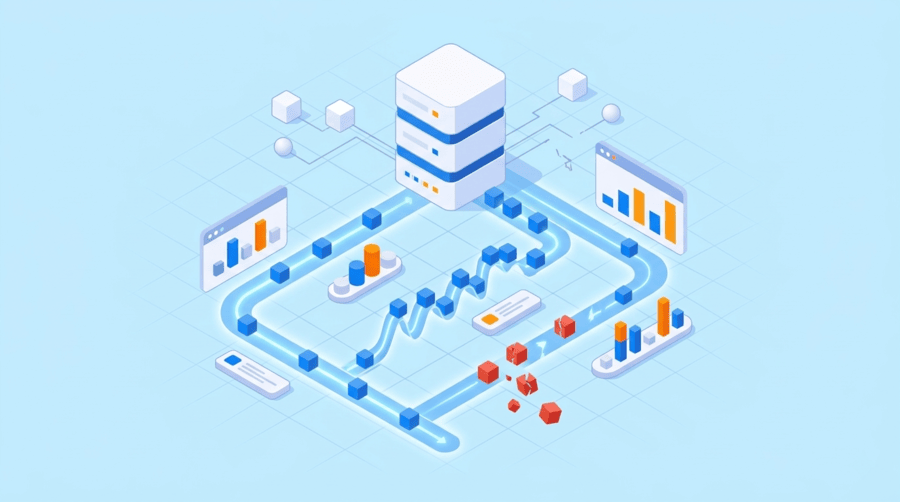
How Do Latency, Jitter, and Packet Loss Affect Application Performance?
In many production environments, application performance problems appear even when bandwidth is plentiful. Teams may upgrade connectivity or deploy powerful servers, yet users still experience slow dashboards, choppy video meetings, or unstable remote sessions.
These issues often trace back to three network performance indicators that operate behind the scenes: latency, jitter, and packet loss. They determine how quickly and consistently data packets travel between systems. When any of them become unstable, application behavior becomes unpredictable.
Understanding how these conditions influence network communication helps teams diagnose performance issues more accurately and design infrastructure that supports reliable applications.
Latency, Jitter, and Packet Loss as Core Network Performance Metrics
Every online application relies on packets moving across routers, switches, and internet exchanges before reaching their destination. The efficiency of this journey can be evaluated using three measurements.
Latency refers to the time required for a packet to travel between two endpoints.
Jitter measures how much that delay varies between packets.
Packet loss occurs when packets fail to arrive at all.
Together these metrics reveal why an application may appear slow or unstable even when bandwidth usage remains low. Monitoring them is a common practice in enterprise networks because they provide early signals of potential network performance issues.
Network Latency Impact on Application Responsiveness
Latency describes the delay between sending a request and receiving a response. While small amounts of delay are unavoidable, excessive latency quickly affects application responsiveness.
Cloud platforms and SaaS tools rely on continuous communication between the client and backend services. Every click or action triggers a request to a server and waits for a reply. When latency increases, each interaction takes longer to complete.
This delay becomes especially noticeable in interactive environments such as remote desktops, database interfaces, and collaboration platforms. Even modest increases can make systems feel sluggish.
Distance between servers, routing complexity, network congestion, and device processing time all contribute to latency.
Tip: Organizations running latency sensitive workloads often deploy infrastructure closer to major internet exchange hubs to shorten network paths and improve response times.
Jitter in Networking and Why Consistency Matters
Latency alone does not tell the whole story. Consistency in packet delivery is equally important.
Jitter in networking refers to variation in packet arrival timing. Ideally packets arrive at predictable intervals, allowing applications to process them smoothly. When congestion or routing changes disrupt that timing, packets arrive unevenly.
Real time services such as video conferencing, VoIP calls, and live streaming are particularly sensitive to jitter. If packets arrive too irregularly, the application must buffer or reorder them to maintain playback. When the variation becomes too large, users begin noticing distorted audio, frozen frames, or delayed responses.
A network may show acceptable average latency but still perform poorly if packet timing fluctuates significantly.
Tip: Dedicated servers connected to stable backbone networks often deliver more consistent packet timing compared with highly shared hosting environments.
Packet Loss Effects on Data Reliability
Packet loss occurs when packets fail to reach their destination. This may happen because of network congestion, hardware faults, or overloaded interfaces.
Its impact depends on the protocol being used. TCP based applications attempt to recover missing packets by retransmitting them, which slows data transfer and reduces throughput. Real time protocols such as UDP do not resend lost packets, so missing data appears as gaps in audio, visual glitches, or dropped sessions.
Even small packet loss effects can significantly disrupt services that depend on continuous data streams.
Tip: Infrastructure with multiple upstream carriers and strong backbone connectivity helps reduce the risk of packet drops during peak traffic periods.
Why Infrastructure Design and Location Matter
Application performance is closely tied to the quality of the underlying network path. Infrastructure located near major internet exchange points often benefits from shorter routes and stronger upstream connectivity.
This improves routing efficiency, reduces latency, and stabilizes packet delivery across long distance connections.
For organizations serving Asia Pacific users, connectivity hubs such as Hong Kong provide strong interconnection between regional networks. Providers operating in these environments, including Dataplugs, maintain high bandwidth capacity and multiple carrier routes to support consistent network performance.
Tip: When evaluating a dedicated server, factors such as network carriers, upstream redundancy, and proximity to internet exchanges can have a major impact on real world performance.
Monitoring Network Performance Metrics
Maintaining reliable applications requires continuous visibility into network behavior. Infrastructure teams commonly monitor metrics such as latency trends, packet loss rates, and link utilization.
Tracking these values helps identify congestion or routing problems before they affect production systems. Establishing performance baselines also allows teams to quickly detect anomalies when network conditions change.
With proper monitoring in place, many network performance issues can be addressed before they escalate into visible service disruptions.
Frequently Asked Questions
What is considered acceptable latency for most applications?
For many enterprise workloads, latency below 50 milliseconds is considered excellent. Interactive applications typically remain usable up to around 100 milliseconds, while higher delays may start affecting user experience.
Is packet loss worse than high latency?
In many cases yes. Applications can often tolerate consistent latency, but packet loss interrupts communication entirely. Lost packets may trigger retransmissions or cause missing audio and video data in real time services.
Can a high bandwidth connection still have poor performance?
Yes. High bandwidth does not guarantee stable performance. If latency, jitter, or packet loss is high, applications can still experience slow responses, lag, or unreliable communication.
Conclusion
Latency, jitter, and packet loss each affect application performance in different ways. Latency introduces delay, jitter disrupts timing consistency, and packet loss interrupts communication entirely. When these conditions occur together, applications may appear slow or unstable even when bandwidth is sufficient.
By monitoring these metrics and deploying infrastructure within well connected network environments, organizations can maintain reliable application performance and improve user experience.
If you are evaluating high bandwidth infrastructure or planning a dedicated server deployment in a major connectivity hub, you can connect with the Dataplugs team via live chat or at sales@dataplugs.com to learn more about available options.