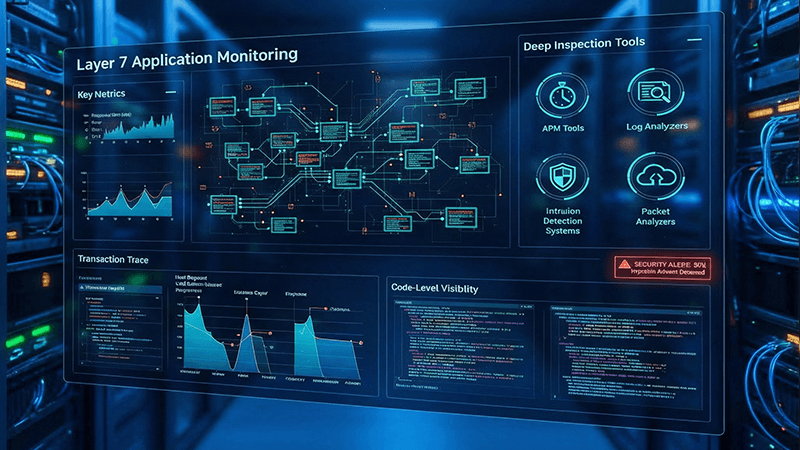
Monitoring Layer 7 Application with Deep Inspection Tools
Application disruptions and undetected security breaches at the application layer are a reality for modern enterprises maintaining critical digital services. Despite extensive investments in infrastructure and firewalls, many organizations face persistent challenges in diagnosing slowdowns, blocking advanced threats, and ensuring compliance when visibility stops at Layer 4. Traditional monitoring tools, designed for basic network flows and port-level statistics, fall short when attackers exploit business logic or when performance issues are rooted in API calls, session management, or encrypted traffic. For businesses relying on complex microservices, SaaS platforms, or customer-facing portals, the need to analyze and control Layer 7 traffic is not only urgent but foundational to operational resilience and user trust.
Layer 7 Application Monitoring: Bridging the Visibility Gap
Legacy network monitoring platforms are inherently limited by their focus on transport and network layers, leaving a critical blind spot at Layer 7. Application layer monitoring enables organizations to see into the heart of digital communications—where actual business transactions, data exchanges, and threat vectors reside. By capturing protocol-specific metrics (HTTP, HTTPS, DNS, SMTP, REST, SOAP) and dissecting payloads, Layer 7 monitoring surfaces actionable insights on user behavior, application logic flow, and potential attack vectors such as SQL injection, cross-site scripting, or session hijacking.
This approach empowers IT teams to detect anomalies like surges in failed login attempts, elevated response times for specific endpoints, or abnormal POST payload sizes—each indicative of either service degradation or a security incident. When monitoring is limited to Layer 4, these events often blend into the noise, delaying detection and escalating risk.
Deep Inspection Tools: From Packets to Protocols
Deep packet inspection (DPI) has evolved from basic header analysis to full application protocol decoding and behavioral analysis. Modern DPI solutions leverage advanced algorithms and AI-driven heuristics to parse encrypted and obfuscated traffic, reconstruct application sessions, and correlate events across distributed environments. Whether deployed as standalone appliances, integrated with next-generation firewalls, or built into service mesh proxies, these tools extract not just who is communicating, but what data is being exchanged, the intent of each operation, and the sequence of actions within an application session.
A comprehensive DPI implementation delivers:
- Real-time detection of protocol misuse and policy violations
- Granular filtering and rate limiting based on application content
- Visibility into encrypted traffic via SSL/TLS decryption (with appropriate keys and policies)
- Context-rich alerts that include user, endpoint, transaction, and payload details
In environments where APIs, cloud workloads, and containerized microservices dominate, DPI enables organizations to enforce business-specific security controls, optimize service quality, and meet regulatory requirements such as PCI DSS, HIPAA, or GDPR.
Layer 7 Traffic Analysis: Metrics, Methodologies, and Use Cases
Effective Layer 7 traffic analysis combines metrics like requests per second, response code distribution, latency percentiles (p50, p90, p99), and error rates, providing a multidimensional view of service health and user experience. By labeling metrics with service name, endpoint, HTTP method, and Kubernetes or cloud metadata, organizations achieve high cardinality analysis—drilling down from global trends to individual user journeys.
Key use cases include:
- Service Level Objective (SLO) enforcement: Proactively monitor and alert on latency or error spikes, ensuring customer-facing services meet contractual performance guarantees.
- Incident response acceleration: Pinpoint failing microservices, database bottlenecks, or authentication issues with real-time, protocol-aware metrics.
- API optimization: Identify slow endpoints, underused features, or inefficient payloads to prioritize development and infrastructure investments.
- Deployment validation: Instantly observe the impact of new code releases or configuration changes on production traffic patterns.
- Threat detection: Surface application-level DDoS attempts, credential stuffing attacks, or data exfiltration hidden within legitimate-looking traffic.
Architecture and Infrastructure for Scalable Application Layer Monitoring
Achieving reliable Layer 7 observability at scale requires infrastructure built for high-throughput data ingestion, processing, and storage. Dedicated servers equipped with multi-core CPUs, NVMe SSDs, and 10GbE+ networking are foundational, especially for environments ingesting gigabits of traffic per second or requiring long-term metric retention. Placement of monitoring infrastructure in geographically strategic data centers, such as Dataplugs’ facilities in Hong Kong, Tokyo, and Los Angeles, enables organizations to comply with data residency requirements while maintaining low-latency access for global users.
Integrating monitoring with container orchestration (Kubernetes), service meshes (Istio, Linkerd), and cloud-native instrumentation (OpenTelemetry, Prometheus) further extends visibility to ephemeral workloads and multi-cloud environments. Automated failover, multi-path networking, and redundant power supplies ensure monitoring continuity even during infrastructure events, aligning with best practices for high availability and disaster recovery.
Data Privacy, Compliance, and Performance Considerations
As application monitoring deepens, organizations must balance visibility with privacy and regulatory mandates. Effective solutions offer granular access controls, data masking, and retention policies to protect sensitive information. Compliance with frameworks such as GDPR and CCPA is supported by audit trails, policy-based data handling, and seamless integration with security operations.
Performance tuning remains a continuous process—balancing metric cardinality, sampling rates, and storage efficiency against the need for actionable insights. Intelligent sampling and adaptive metric collection allow organizations to capture 100% of critical transactions (such as payments or logins) while sampling less critical flows. This ensures operational relevance without straining resources.
Strategic Value of Layer 7 Monitoring for Business Operations
For industries where downtime or data breaches have direct financial and reputational impact—finance, healthcare, e-commerce, and media—Layer 7 monitoring is a strategic enabler. It transforms raw network data into business context, supports automation of compliance reporting, and strengthens customer trust through proactive incident management.
How Dataplugs Supports Advanced Layer 7 Application Monitoring
Organizations looking to operationalize deep application layer monitoring benefit from a robust infrastructure foundation. Dataplugs empowers clients with:
- Customizable dedicated servers featuring the latest Intel and AMD processors, paired with high-speed NVMe SSDs for rapid data processing
- Tier 3+ data centers in Hong Kong, Tokyo, and Los Angeles, offering local compliance and global reach
- Multi-path BGP networking, direct China and international routes, and integration with multiple Tier-1 ISPs for optimized traffic flow and resilience
- High-availability network design, redundant power sources, and enterprise-grade security measures including DDoS protection and Web Application Firewall
- Rapid server provisioning and flexible configurations tailored for high-throughput monitoring workloads
- 24/7 bilingual technical support and managed services, ensuring uninterrupted operations and expert guidance at every stage
Conclusion
Robust application layer monitoring and deep inspection capabilities are now central to digital service reliability, security, and optimization. As application environments become more complex and threats more sophisticated, organizations that invest in advanced Layer 7 traffic analysis and DPI solutions are better positioned to detect anomalies, enforce compliance, and deliver superior user experiences. Dataplugs offers the infrastructure and expertise required to make this transformation achievable—enabling enterprises to deploy, scale, and optimize monitoring platforms tailored to their unique business needs. To explore server solutions and custom architectures for Layer 7 monitoring, reach out via live chat or email sales@dataplugs.com.