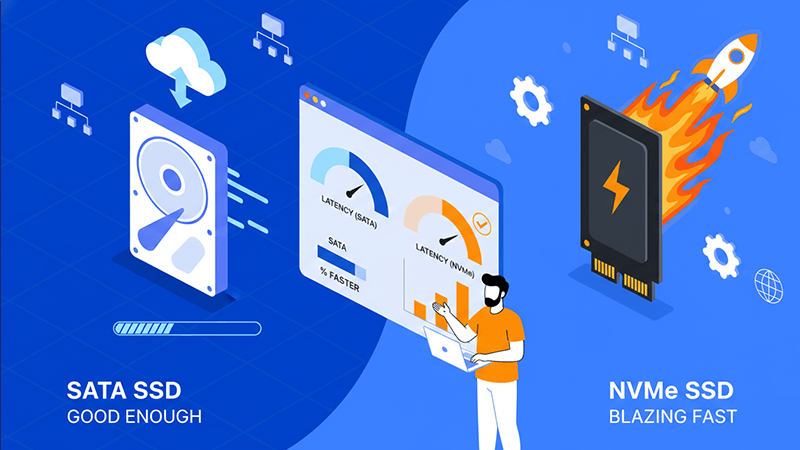
NVMe vs. SATA SSD: When Does Your Business Actually Need the Extra Speed?
At a certain point in a company’s growth, infrastructure decisions stop being purely technical and start shaping daily operations. Systems may appear stable, yet teams notice subtle slowdowns during peak hours. Reports take longer to generate. Virtual machines hesitate during snapshots. Applications remain online, but responsiveness feels inconsistent. These moments are rarely caused by insufficient CPU power. More often, they trace back to how storage handles pressure.
This is where the discussion around NVMe vs SATA SSD becomes relevant for businesses. Not as a theoretical comparison, but as a practical decision about how reliably systems perform when usage is no longer predictable.
How modern business workloads stress storage differently
Business infrastructure has changed significantly over the last decade. Servers are no longer dedicated to a single task. A single machine may host databases, application services, background jobs, monitoring tools, and backups simultaneously. Cloud native architectures and virtualization further increase storage concurrency.
These environments generate constant random read and write operations rather than long sequential transfers. Logs are written continuously. Databases update indexes in real time. Virtual machines perform housekeeping tasks alongside user activity. Storage must respond to thousands of small requests with minimal delay.
When storage cannot keep up, performance degradation spreads across the stack. CPUs wait for I O. Applications queue requests. End users experience slow responses without obvious errors. This is why storage architecture has become a decisive factor in business SSD storage planning.
What SATA SSD performance delivers and where it plateaus
SATA SSDs were a transformative upgrade from HDDs. Removing mechanical parts reduced access latency dramatically and improved reliability. For many organizations, switching to SATA SSDs solved years of performance complaints overnight.
However, SATA SSD performance is limited by two structural factors. The SATA III interface caps throughput at around 600 MB per second. More critically, the AHCI protocol processes commands in a largely serial manner with shallow queues. This design was never intended for highly parallel flash memory.
In real business environments, SATA SSDs perform well when:
- User concurrency is limited
- Access patterns are predictable
- Applications are not latency sensitive
- Storage I O peaks are infrequent
Examples include internal file servers, document management systems, static websites, and smaller line of business applications. In these scenarios, SATA SSDs remain a sensible and cost efficient choice.
Why NVMe exists and what it changes architecturally
NVMe, or Non Volatile Memory Express, was designed specifically to unlock the potential of flash storage. Instead of adapting legacy disk protocols, NVMe communicates directly over PCIe lanes and aligns with modern CPU architectures.
Key architectural differences include:
- Tens of thousands of parallel command queues
- Deep queue depths per queue
- Lower per operation latency
- Better utilization of multicore CPUs
NVMe SSD speed is often described in terms of multi gigabyte per second throughput, but for businesses, the more meaningful advantage is consistency. NVMe handles bursts of concurrent I O without the same latency spikes seen in SATA based systems.
NVMe SSD vs SATA SSD in real business workloads
In light usage scenarios, the difference between NVMe and SATA SSDs may feel subtle. Systems boot quickly on both. Applications launch without noticeable delay. This leads many teams to assume NVMe offers limited practical value.
The distinction becomes clear under load:
- Multiple users accessing the same database
- Several virtual machines performing disk operations simultaneously
- Backup jobs running alongside production traffic
- Analytics or reporting queries scanning large datasets
Under these conditions, SATA SSDs begin to queue operations, increasing response times unevenly. NVMe continues to process requests in parallel, keeping latency predictable. For business systems, predictability often matters more than peak speed.
Virtualization, containers, and storage contention
Virtualized environments amplify storage pressure. Each VM behaves like an independent server, generating its own I O patterns. As VM density increases, storage becomes the shared resource most likely to bottleneck.
NVMe provides tangible benefits for virtualization:
- Higher VM density per host without performance collapse
- Faster provisioning and cloning
- Reduced impact of snapshots and backups
- More stable performance isolation between workloads
For businesses running private clouds, hypervisors, or managed platforms, NVMe is often the key to scaling without adding unnecessary hardware.
Databases and transaction driven systems
Databases are particularly sensitive to storage latency. Even small delays during write commits or index access can ripple through applications and user interactions.
NVMe improves database behavior by:
- Reducing transaction commit times
- Supporting higher IOPS under concurrency
- Improving index and metadata access
- Maintaining responsiveness during mixed read write workloads
This is critical for ecommerce platforms, SaaS products, financial systems, and any application where response time directly affects revenue or user trust.
Cost considerations beyond the drive label
While NVMe once carried a clear price premium, the gap has narrowed. Entry level NVMe SSDs often compete closely with higher end SATA models. In some cases, NVMe delivers better performance per dollar.
More importantly, storage decisions influence total cost of ownership:
- Fewer servers needed due to higher workload density
- Reduced downtime risk during peak periods
- Improved staff productivity from faster systems
- Longer useful lifespan of existing hardware
When these factors are considered, NVMe often becomes a rational business investment rather than an optional upgrade.
Hybrid storage strategies in practice
Not every workload requires NVMe. Many organizations adopt a layered approach:
- NVMe for operating systems, databases, and active workloads
- SATA SSDs for file storage and secondary services
- HDDs reserved for archives and backups
This strategy aligns storage performance with data access patterns, optimizing both cost and efficiency.
Dataplugs NVMe SSD all flash dedicated servers
For businesses that require consistent, high performance storage without shared resource contention, Dataplugs offers NVMe SSD all flash dedicated servers. These servers are designed for workloads where storage latency and I O consistency directly impact application behavior.
Dataplugs NVMe dedicated servers provide:
- All flash NVMe SSD storage with direct PCIe access
- Single tenant hardware for predictable performance
- High IOPS capability suitable for databases and virtualization
- Enterprise grade CPUs and ECC memory options
- High bandwidth network connectivity for low latency access
These servers are commonly used for:
- Business critical databases
- Virtualized production environments
- High traffic web and application servers
- SaaS and managed service platforms
Deployed across multiple Tier 3+ data centers in regions such as Hong Kong, Tokyo, and Los Angeles, Dataplugs infrastructure helps ensure that storage speed gains are not offset by network latency. Full root access allows businesses to tune their systems precisely to workload requirements, maintaining control over security, compliance, and performance optimization.
Conclusion
The NVMe vs SATA SSD decision is ultimately about aligning storage behavior with how your business systems operate in reality. SATA SSD performance remains more than adequate for stable, low concurrency workloads. NVMe becomes necessary when storage responsiveness limits scalability, reliability, or user experience.
As business environments grow more dynamic and interconnected, storage is no longer a passive component. It actively defines how far infrastructure can scale and how consistently it performs. Choosing NVMe at the right stage removes constraints that CPU and memory upgrades alone cannot solve.
Dataplugs supports businesses making this transition by offering NVMe SSD all flash dedicated servers designed for sustained, real world workloads across global locations. For more details, you can connect with their team via live chat or email at sales@dataplugs.com.