What Are NVMe RAID Levels and How Do They Support High Availability Hosting?
In production hosting environments, storage failure rarely announces itself loudly. It appears as elevated latency during peak traffic, inconsistent database response times, or degraded performance during rebuild cycles. For organizations operating revenue generating platforms, infrastructure must remain stable not only during ideal conditions but also when hardware components fail. This is where NVMe RAID levels become central to high availability hosting storage design.
Why NVMe Changes the Storage Equation
NVMe, or Non Volatile Memory Express, was engineered specifically for flash storage and communicates directly with the CPU over PCIe lanes. Unlike legacy SATA or SAS interfaces, NVMe supports parallel command queues and dramatically lower latency. In real world hosting environments, this translates into faster database transactions, improved virtualization density, and reduced I/O bottlenecks under concurrency.
However, performance alone does not deliver uptime. A single NVMe drive, regardless of its speed, still represents a single point of failure. RAID architecture transforms raw performance into resilient infrastructure. In high availability hosting storage environments, redundancy is not an optional enhancement. It is structural engineering.
Understanding NVMe RAID Levels in Enterprise Hosting
RAID, or Redundant Array of Independent Disks, aggregates multiple physical drives into a single logical unit. Different RAID levels determine how data is distributed and protected. When deployed with NVMe SSDs, these configurations allow hosting environments to preserve ultra low latency while introducing structured redundancy models suited for enterprise operations.
RAID 0 is based on striping. Data is divided across multiple NVMe drives and processed in parallel, significantly increasing throughput. For compute heavy or temporary workloads where speed is the primary objective, RAID 0 can be effective. The limitation is clear. It provides no redundancy. If a single drive fails, the entire array becomes unavailable. In high availability hosting environments, RAID 0 alone is rarely sufficient.
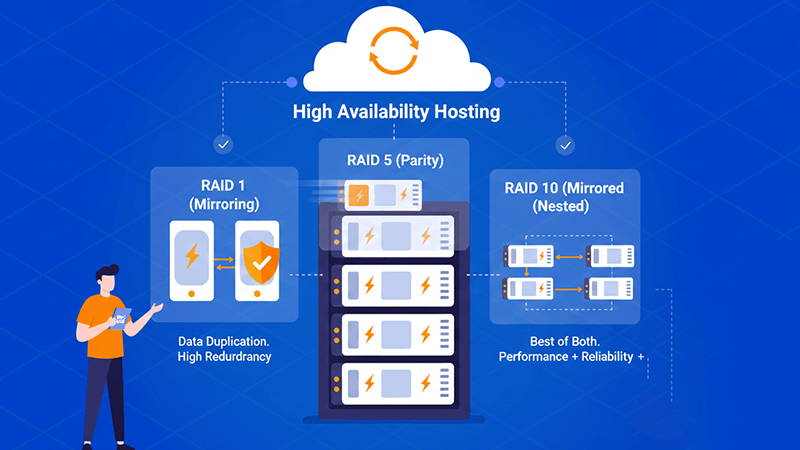
RAID 1 introduces mirroring. Identical data is written to two NVMe drives simultaneously. If one drive fails, the surviving drive continues operating without service interruption. This configuration emphasizes data integrity and immediate failover. The trade off is capacity efficiency, as half of the total storage is dedicated to redundancy. For many deployments, especially smaller production systems, RAID 1 provides a dependable foundation.
RAID 5 combines striping with distributed parity across at least three NVMe drives. If one drive fails, parity information allows data reconstruction. NVMe reduces the performance penalty traditionally associated with parity operations, yet rebuild cycles still require careful workload management. RAID 5 is often selected when organizations seek a balance between storage efficiency and fault tolerance.
RAID 10 integrates mirroring and striping. It requires a minimum of four NVMe drives and delivers both strong redundancy and sustained performance. Because data is mirrored in pairs and striped across those pairs, rebuild operations affect only a subset of the array. This results in more stable performance under failure conditions compared to parity based configurations.
NVMe RAID Levels Comparison for High Availability Hosting
Below is a simplified comparison of the primary NVMe RAID levels used in enterprise and high availability hosting storage environments:
RAID Level | Minimum Drives | Performance Profile | Redundancy Level | Suitable For |
RAID 0 | 2 | Maximum read and write throughput | None | Temporary workloads, high speed processing with external backups |
RAID 1 | 2 | Strong read performance, stable writes | Full mirror protection | Small to mid size production systems requiring immediate failover |
RAID 5 | 3 | Balanced performance with parity overhead | Single drive fault tolerance | Storage efficient production environments |
RAID 10 | 4 | High sustained performance under load | Mirror + striping protection | Databases, virtualization clusters, transaction heavy applications |
This comparison highlights why NVMe RAID 1 vs RAID 10 is a frequent consideration in enterprise NVMe storage solutions. While RAID 1 offers simplicity and dependable redundancy, RAID 10 provides enhanced scalability and performance stability during rebuild cycles.
NVMe RAID 1 vs RAID 10 in High Availability Hosting
When comparing NVMe RAID 1 vs RAID 10, the decision often depends on workload intensity and performance consistency requirements. RAID 1 offers simplicity and immediate redundancy. It is well suited for moderate workloads where predictable behavior is sufficient.
RAID 10, by contrast, is designed for environments with high concurrency and transaction volume. Database clusters, virtualization hosts, SaaS applications, and financial platforms benefit from RAID 10’s ability to maintain throughput during drive rebuilds. In enterprise NVMe storage solutions supporting production systems, RAID 10 is frequently selected because it minimizes performance variance while maintaining strong redundancy.
How NVMe RAID Supports High Availability Hosting Storage
High availability hosting storage is defined by the elimination of single points of failure. NVMe RAID ensures that a single drive malfunction does not translate into service downtime. During maintenance windows or unexpected hardware replacement, applications remain accessible and transactions continue processing.
In hosting ecosystems involving hypervisors, container orchestration platforms, distributed databases, and caching layers, storage stability under concurrency is critical. NVMe RAID reduces rebuild duration compared to legacy disk arrays and maintains parallel processing capability even when operating in a degraded state. This stability directly supports uptime commitments and service level agreements.
Dataplugs Dedicated Servers and NVMe RAID Architecture
Storage redundancy achieves its full value only when aligned with power, cooling, and network architecture. Dataplugs dedicated servers are deployed within enterprise grade data center environments where NVMe RAID configurations operate alongside redundant power infrastructure and premium network backbone connectivity.
For organizations implementing NVMe RAID for high availability hosting, Dataplugs offers configurable dedicated server platforms supporting RAID 1 and RAID 10 NVMe setups tailored to workload demands. Dedicated resource allocation ensures that storage performance is not influenced by external tenants, maintaining consistent latency and predictable throughput.
Strategically located data centers across Asia Pacific provide low latency regional connectivity, while structured power redundancy and carrier diverse uplinks reinforce infrastructure resilience. By aligning NVMe RAID architecture with dedicated compute isolation and network stability, Dataplugs enables enterprises to build high availability hosting storage environments engineered for operational continuity.
Enterprise NVMe Storage Solutions Require Layered Infrastructure
Enterprise NVMe storage solutions do not function in isolation. They integrate with redundant power supply systems, UPS backed electrical design, generator support, environmental control mechanisms, and optimized routing architecture. Availability is cumulative across infrastructure layers.
A mirrored array without upstream power redundancy remains exposed. A high speed array without network resilience cannot sustain uptime under carrier failure. When NVMe RAID configurations are deployed within properly engineered facilities, storage becomes part of a coordinated reliability model rather than a standalone component.
Engineering Storage for Continuity Rather Than Recovery
The selection of NVMe RAID levels should reflect transaction volume, concurrency behavior, acceptable rebuild performance impact, and long term scalability objectives. RAID 0 prioritizes speed without protection. RAID 1 delivers straightforward redundancy for moderate workloads. RAID 5 balances efficiency and resilience. RAID 10 provides the strongest combination of sustained performance and fault tolerance for demanding enterprise systems.
In high availability hosting, storage architecture determines how infrastructure behaves when hardware inevitably fails. NVMe RAID transforms flash performance into engineered continuity. When integrated within dedicated server environments built for resilience, such as those provided by Dataplugs, storage becomes a foundational component of uptime strategy rather than a reactive safeguard.
Organizations evaluating enterprise NVMe storage solutions for mission critical deployments across Asia Pacific can connect with the Dataplugs team via live chat or at sales@dataplugs.com to discuss NVMe RAID configurations aligned with long term operational stability and scalability. In environments where downtime is unacceptable, engineered redundancy at the storage layer is not optional. It is foundational.