What Are the Different Power Redundancy Options Available in Dedicated Servers?
In production infrastructure, power design determines how long systems remain stable when conditions are no longer ideal. A dedicated server can have enterprise grade processors, NVMe storage, and high throughput networking, yet a single electrical interruption can neutralize all of it in milliseconds. In environments where uptime commitments are contractually defined and performance consistency affects revenue, power redundancy is not an accessory feature. It is structural engineering.
Organizations searching for power redundancy options in dedicated servers are typically not looking for theory. They are evaluating how different electrical configurations influence risk exposure, maintenance flexibility, and long term operational continuity. The distinction between a single PSU, a dual power supply configuration, and an A+B power dedicated server model is not incremental. It represents fundamentally different reliability architectures.
Understanding How Power Reaches a Dedicated Server
Before evaluating redundancy models, it is necessary to understand the electrical chain that supports a dedicated server. Power originates from the utility grid and enters the data center through substations and high voltage feeds. It passes through transformers, switchgear, and automatic transfer switches before reaching Uninterruptible Power Supply systems. From there, it flows into rack level Power Distribution Units and finally into the server’s internal power supplies.
Redundancy can exist at each of these layers. Some facilities duplicate only UPS modules. Others provide independent utility feeds. The highest levels of data center power redundancy duplicate the entire electrical path from grid entry to rack delivery. The effectiveness of any dedicated server power redundancy strategy depends on how many of these layers are isolated from one another and whether they can independently sustain the full load.
Single Power Supply Configuration: Baseline Availability
The simplest model is a single power supply dedicated server connected to one PDU and one upstream power feed. This aligns with what infrastructure standards describe as N redundancy, meaning only the required capacity is provisioned with no backup.
Under normal operating conditions, this configuration performs adequately. However, if the internal PSU fails, the server immediately powers off. If the rack PDU experiences a fault, the outcome is the same. Maintenance at the electrical distribution level may also require downtime. This design is typically reserved for development environments, short term deployments, or workloads where temporary interruption does not materially impact business operations.
From an engineering perspective, the limitation is clear: a single point of failure exists at multiple layers.
Dual Power Supply Server Hosting: Hardware Level Redundancy
Dual power supply server hosting introduces redundancy at the server chassis level. In this configuration, the machine contains two hot swappable PSUs. Each unit is capable of independently sustaining the server’s full electrical load.
When properly implemented, each PSU connects to a separate rack PDU. If one power supply fails, the other immediately maintains operation without performance degradation. Because the modules are hot swappable, replacement can occur without shutting down the system. This significantly reduces the risk of hardware induced outages.
However, while dual PSU architecture protects against internal component failure, it does not automatically eliminate upstream risks. If both PSUs draw from the same electrical path, a failure at the PDU or UPS layer could still interrupt service. True resilience requires separation beyond the chassis itself.
A+B Power Dedicated Server: Path Level Isolation
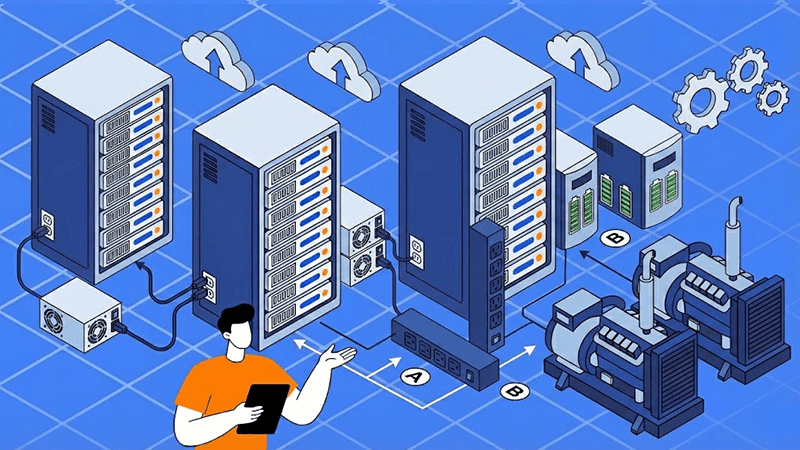
An A+B power dedicated server configuration elevates redundancy from component protection to path isolation. In this model, PSU A connects to Power Feed A and PSU B connects to Power Feed B. Each feed is backed by separate UPS systems and, in higher tier facilities, separate generators and possibly independent utility feeds.
This architecture aligns with Tier III and Tier IV data center principles as defined by the Uptime Institute. The objective is concurrent maintainability and fault tolerance. If Feed A undergoes maintenance or experiences failure, Feed B continues supplying uninterrupted power. The server transitions seamlessly without manual intervention.
The difference between dual PSU and A+B power lies in electrical independence. With A+B design, the failure of an entire power path does not disrupt operations. This is the configuration most commonly selected for financial platforms, healthcare systems, distributed database clusters, and other mission critical workloads where downtime tolerance is minimal.
N+1, 2N, and Full Redundancy in Data Center Design
To fully understand dedicated server power redundancy, server configuration must be viewed in context with facility architecture. Infrastructure redundancy is often described using formulas such as N, N+1, and 2N.
N redundancy means only the minimum required capacity exists. N+1 adds one additional component beyond the required load. For example, three UPS modules may support a load that only requires two. If one fails, the remaining two sustain operation.
2N redundancy represents two completely independent systems, each capable of handling 100 percent of the load. This is commonly referred to as full redundancy. In such environments, there are effectively two separate data centers sharing the same physical footprint, at least from a power perspective.
When an A+B power dedicated server is deployed inside a 2N facility, every layer from utility entry to rack distribution is duplicated. This removes single points of failure across the electrical chain and provides the highest degree of infrastructure resilience available in commercial data centers.
Full Redundancy Versus Fault Tolerant Redundancy
It is also important to distinguish between maintaining uptime and maintaining performance during failure scenarios. In full redundancy configurations, the remaining power path is sized to sustain full system performance even after losing one feed or PSU. Workloads continue operating without throttling.
In certain fault tolerant redundancy models, intelligent power management systems may reduce system performance after a failure to keep power consumption within the limits of the surviving infrastructure. While service remains online, computational output may decrease temporarily.
For compute intensive applications such as AI training nodes, high frequency transaction systems, or real time analytics platforms, consistent performance during failover events is critical. In those scenarios, full redundancy design is operationally preferable.
The Role of UPS and Generator Systems
Redundant server PSUs alone cannot guarantee uptime if upstream systems are not equally resilient. Enterprise grade data center power redundancy typically includes battery backed UPS systems that bridge short term interruptions in milliseconds, as well as diesel or natural gas generators that activate during extended outages.
Automatic Transfer Switches monitor power quality and shift load between sources when anomalies are detected. Independent substations, where available, further reduce the likelihood of simultaneous feed failure.
UPS systems protect against voltage fluctuations and brownouts. Generators protect against prolonged grid outages. Together, they form the backbone of a comprehensive server uptime solution.
Aligning Redundancy with Workload Criticality
Selecting the appropriate redundancy model requires evaluating business tolerance for downtime and performance variance. Organizations must consider Recovery Time Objectives, Service Level Agreements, regulatory obligations, and the financial impact of service interruption.
Single PSU configurations may suffice for non production workloads. Dual PSU deployments offer solid protection against hardware failure. A+B power dedicated server configurations within a 2N data center environment support mission critical operations where downtime risk must be engineered toward near zero.
The central principle remains consistent: eliminate single points of failure wherever practical.
Infrastructure Stability and Dataplugs Dedicated Servers
Infrastructure reliability is not solely determined by server specifications. It is shaped by the alignment between server hardware and facility architecture. Dataplugs deploys dedicated servers within enterprise grade data center environments designed with redundant power infrastructure and high availability network backbones. Dual power supply configurations and structured A+B power options allow businesses to architect infrastructure according to workload sensitivity rather than compromise due to limitations.
For latency sensitive deployments and cross border digital services across Asia Pacific, predictable electrical design and optimized backbone connectivity work together to minimize operational variance. When power topology is engineered with independence from grid entry to rack distribution, infrastructure behaves deterministically. That determinism is foundational to long term uptime.
Conclusion
Power redundancy options in dedicated servers range from basic single PSU configurations to fully isolated A+B power architectures backed by independent UPS systems and utility feeds. The differences are not cosmetic. They represent distinct reliability philosophies.
Single PSU designs provide minimal protection. Dual power supply server hosting eliminates hardware level failure risk. A+B power dedicated server configurations introduce true electrical path separation. When combined with 2N facility architecture, the result is comprehensive data center power redundancy engineered for continuity.
Organizations evaluating dedicated infrastructure for performance sensitive or mission critical workloads should treat electrical design as a primary architectural decision. Those seeking structured guidance can connect with the Dataplugs team via live chat or at sales@dataplugs.com to explore configurations aligned with long term operational resilience and scalable growth.