What Are the Network Characteristics of Japan Based Data Centers?
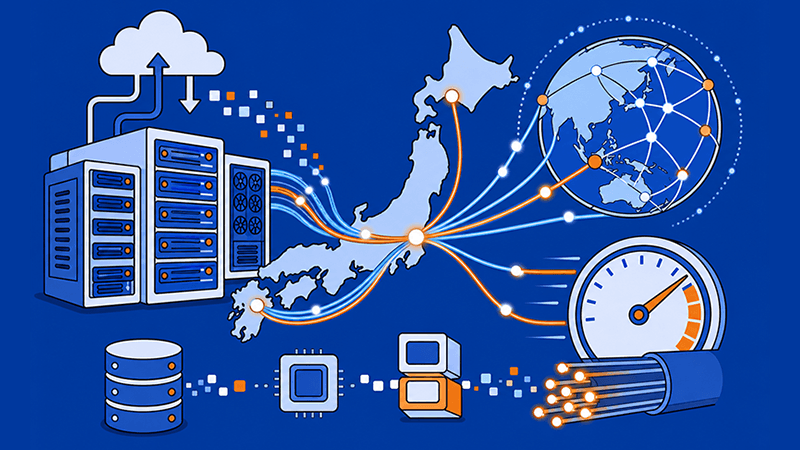
When businesses evaluate Japan for hosting, cloud connectivity, or regional infrastructure, the key issue is usually not whether Japan is mature. It is whether the network can support the workload properly. A deployment may look strong on paper, but if latency fluctuates, routes to Southeast Asia are inconsistent, or resilience planning is weak, the impact shows up quickly in user experience and operations.
Japan matters because it combines dense telecom infrastructure, strong domestic fiber networks, major submarine cable access, and established data center ecosystems in Tokyo and Osaka. For companies serving Japan, North Asia, or wider APAC markets, these network traits can make Japan a strong production site, recovery location, or part of a multi-metro strategy.
Why Japan is a strong network location in Asia
Japan is one of the most important data center markets in the developed world, supported by strong infrastructure, political stability, low outage rates, and its role as a connection point between North America and Asia-Pacific. That makes it relevant for enterprise systems, e-commerce platforms, media delivery, SaaS, and private infrastructure serving multiple Asian markets.
For many businesses, Japan works well because it can support domestic traffic while still offering useful regional reach. Instead of being only a local market deployment, it can serve as a regional infrastructure base depending on the provider’s carrier mix and routing quality.
Latency is important, but route quality matters more
Latency is often the first thing buyers ask about, but route quality is usually more important than a single number. Japan can deliver solid regional performance, but the real result depends on upstream carriers, peering quality, and routing design.
Reference data for Tokyo to Southeast Asia shows useful performance ranges, including around 65 to 85ms to Singapore, 85 to 100ms to Jakarta, 75 to 90ms to Bangkok, and 80 to 95ms to Ho Chi Minh City under better conditions. That is suitable for many websites, APIs, business systems, and platform workloads. But another provider in the same metro may perform differently if its network design is weaker.
This is why businesses should not compare Japan hosting by city name alone. The route behind the server matters.
Submarine cable access supports international performance
One of the main network characteristics of Japan based data centers is strong access to international submarine cable systems. Japan benefits from multiple cable routes into Southeast Asia, Hong Kong, East Asia, and North America, giving the market useful bandwidth capacity and path diversity.
This matters because cable diversity improves resilience. If one route is congested or disrupted, traffic has more chance of being rerouted efficiently. For businesses delivering cross-border applications, content, or enterprise traffic, this is a major advantage.
Tokyo and Osaka often serve different roles
Tokyo and Osaka should not be treated as interchangeable. Tokyo is often preferred for interconnection-heavy deployments because of its deeper carrier ecosystem, cloud adjacency, and stronger partner reach. It usually fits businesses that need network depth at the first site.
Osaka is often more relevant for resilience, workload distribution, and second-metro separation inside Japan. For companies planning continuity or a dual-metro model, Osaka can become an important part of the architecture much earlier than expected.
The better question is not which city is better overall. It is which city better matches the workload role.
BGP design, carrier diversity, and interconnection matter
A strong Japan deployment depends heavily on BGP architecture, carrier diversity, and interconnection options. These factors affect route stability, failover quality, and long-term scalability more than many buyers expect.
For businesses serving regional users, mature BGP design and multiple carrier relationships can make a visible difference in delivery consistency. Dataplugs reflects this kind of setup through its global BGP network and Tokyo dedicated server options, which may suit businesses that need stable regional hosting rather than only raw hardware.
Tip: review route quality, carrier design, and test data before comparing only CPU or RAM.
Performance to Southeast Asia can be practical
Japan is often viewed mainly as a North Asia location, but it can also perform well for Southeast Asia depending on the workload. For many web applications, APIs, SaaS platforms, and e-commerce services, Tokyo can provide practical regional performance when the provider’s network is built properly.
This can be useful for businesses that want one regional base instead of maintaining several fragmented deployments. Japan may not replace every local edge strategy in ASEAN, but it can work well as a central node for mixed Asia traffic.
China-facing traffic needs separate evaluation
For businesses serving Mainland China as part of a wider Asia strategy, Japan should be reviewed more carefully. Proximity alone does not guarantee good China-facing performance. What matters is route quality, carrier relationships, and whether the provider offers China-optimized network options.
Traffic into different Mainland cities can behave differently, so route testing is important. This is where providers with CN2-related connectivity options may be more useful depending on the traffic pattern. Dataplugs offers Japan dedicated server services alongside CN2 Direct China server options, which may help businesses that need to balance Japan deployment with China-facing access.
Power, scaling, and future growth matter too
Network quality is not only about what happens today. It is also about whether the site can support future expansion. Japan’s data center market is growing quickly, with AI demand increasing pressure on power availability and higher-density deployments.
That means businesses should look beyond latency and bandwidth and ask whether a site can scale well over time. A location with strong connectivity but limited expansion headroom may not be the best long-term choice. Tokyo and Osaka can differ in power conditions, land availability, and build timelines, which affects future deployment planning as much as network design.
Resilience, security, and future capacity still matter
Speed alone is not enough. Buyers also need to assess route redundancy, metro diversity, security protections, and long-term expansion conditions. Tokyo and Osaka are both important here, especially for businesses planning second-site separation inside Japan.
Security also affects availability. DDoS protection, firewalls, WAF, and responsive technical support all help preserve network quality during attacks or instability. Dataplugs supports this layer with Anti-DDoS protection, firewall protection, WAF, and 24/7 technical support, which is useful for businesses that need dependable uptime.
Japan’s future growth is also tied to power availability and AI-driven demand. A site with strong connectivity today should also be reviewed for long-term expansion readiness.
Conclusion
The network characteristics of Japan based data centers are shaped by low-latency regional reach, strong submarine cable connectivity, mature carrier ecosystems, and the different roles of Tokyo and Osaka. For the right workload, Japan can be an effective location for production, resilience, and regional growth.
For businesses reviewing Japan hosting options, Dataplugs is worth considering for Tokyo dedicated servers, global BGP connectivity, and supporting security services. You can contact the team via live chat or email at sales@dataplugs.com.