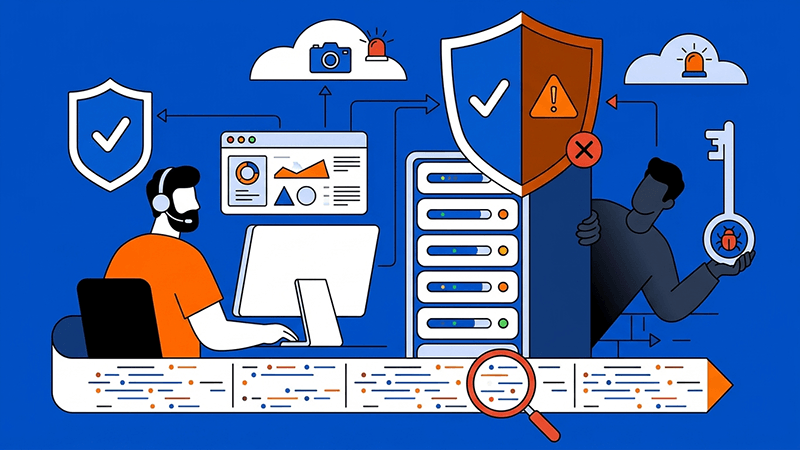
How can you manage insider risk in server administration environments?
A server breach does not always begin with malware or an exposed service. In many cases, it begins with valid access used at the wrong time, in the wrong way, or with too much freedom. In server administration environments, that is what makes insider risk difficult. The commands may be legitimate. The login may be approved. The transfer may use an ordinary tool. By the time someone notices, sensitive data may already be copied, logging may be altered, or a production system may have been changed without proper review.
Why server administration environments need closer control
Server administrators often work with elevated permissions across operating systems, databases, storage, backups, and network-connected systems. That level of access is necessary for operations, but it also creates a narrow margin for error. A careless action can expose credentials or misconfigure access. A malicious action can lead to data theft, service disruption, or deletion of critical records. A compromised admin account can be even harder to detect because the attacker appears to be operating as a trusted user.
Traditional security controls alone do not fully solve this problem. Firewalls and endpoint tools are designed to stop unauthorized entry, but they do not always distinguish between normal admin activity and misuse carried out through valid credentials. Managing insider risk in this environment depends on limiting power, increasing visibility, and making sensitive actions accountable.
Start with least privilege
The most effective control is to reduce unnecessary access before misuse happens. Many organizations allow permissions to accumulate over time through role changes, temporary projects, or operational shortcuts. That creates broad standing access that is difficult to justify and even harder to monitor properly.
Least privilege means administrators receive only the permissions required for their job at that time. Separate standard and administrative accounts should be used wherever possible, and access should be reviewed regularly so old privileges do not linger beyond their purpose.
Tip: If an account has access “just in case,” it probably has too much access.
Use PAM for stronger control over admin access
Privileged Access Management helps reduce risk by placing elevated access behind approval, time limits, and audit trails. Instead of allowing administrators to hold permanent high-level permissions, PAM makes access more deliberate and easier to review later.
This is especially useful in server administration because the highest-risk actions often involve exactly the kind of access that should not remain open all day. Credential vaulting, Just-in-Time elevation, and session recording help reduce both insider misuse and the impact of stolen admin credentials.
- Vault privileged credentials
- Enforce time-bound elevation
- Record sensitive admin sessions
- Track approvals and audit trails
Monitor behavior, not just logins
In server environments, a successful login tells very little on its own. The more important question is what the user did after login, whether it fits their normal role, and where the data or configuration changes went. A bulk export at midnight, a new remote tool, or access to directories outside a person’s normal scope may be more meaningful than a failed authentication alert.
Behavior monitoring works best when tied to context. Security teams should look for unusual data access volume, off-hours administration, rare tool usage, and transfers to unsanctioned destinations. The goal is not to treat every action as suspicious, but to identify actions that no longer fit the expected pattern.
Tip: A valid login is not proof that the activity is valid.
Protect data movement and remote access paths
Many insider incidents are only discovered after data has already left the environment. That is why monitoring access alone is not enough. Organizations should also control how sensitive files move across email, cloud storage, USB devices, remote copy tools, and administrative sessions.
Remote access needs the same level of discipline. MFA, managed devices, VPN controls, bastion hosts, and alerting on unusual remote behavior all help reduce exposure. This becomes even more important when administrators support systems across multiple regions or work outside standard business hours.
Tip: The real risk often begins after access is granted, not before.
Build stronger offboarding and audit discipline
Departing employees, contractors, and role changes deserve more attention in server environments because that is when incentives and access levels can shift quickly. Access should be revoked immediately when responsibilities end, and recent privileged activity should be reviewable without delay.
Good auditing should support investigations, not just compliance. Teams should be able to see who performed an action, what was changed, whether privileged elevation was involved, and whether the behavior matched an approved workflow. Without that clarity, insider incidents become slower and more expensive to contain.
Choose infrastructure that supports control
Insider risk management is easier when infrastructure is stable, segmented, and operationally visible. Businesses that depend on dedicated servers for sensitive workloads should not only think about compute and bandwidth, but also about how well the environment supports privileged access control, auditability, and secure remote administration.
Dataplugs supports these operational needs with dedicated server deployments in Hong Kong, Tokyo, and Los Angeles, backed by global BGP connectivity, CN2-optimized options for China-related traffic, and enterprise hosting environments that help teams apply governance with greater consistency.
Conclusion
To manage insider risk in server administration environments, focus on reducing unnecessary privileges, controlling elevated access, monitoring behavior in context, and protecting data movement after login. The strongest approach combines least privilege, PAM, MFA, auditing, and clear governance so misuse can be prevented early or detected before it turns into a larger incident.
For organizations running critical workloads, Dataplugs provides dedicated server infrastructure that supports secure operations, visibility, and reliable administrative control.
For more information, visit Dataplugs or contact sales@dataplugs.com.