Service Mesh Considerations for Bare Metal Kubernetes Environments
A service mesh can make communication between Kubernetes workloads more secure, observable, and policy-driven. On bare metal, however, the mesh cannot be separated from the physical infrastructure beneath the cluster. Node topology, network paths, CPU and memory headroom, storage latency, and failure domains all affect how well the mesh behaves in production.
What a service mesh changes in a bare metal cluster
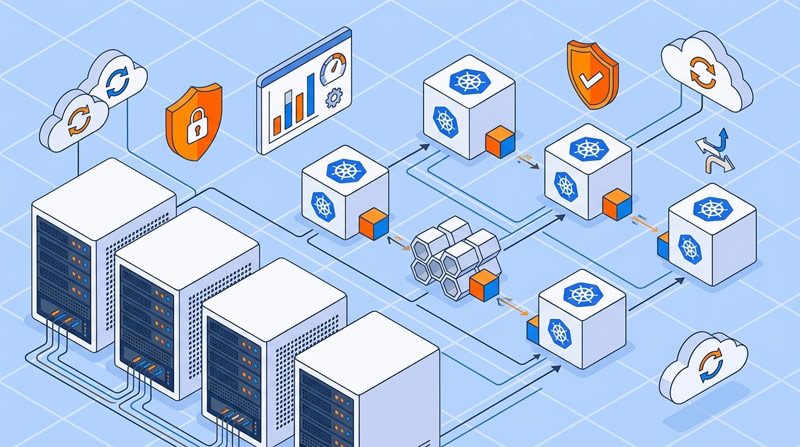
A service mesh adds a dedicated communication layer between services. Depending on the implementation, a sidecar proxy or node-level data plane handles traffic policy, service discovery, encryption, retries, and telemetry while a control plane distributes configuration and identity information. This reduces the amount of networking logic each application must implement, but it also adds another operational system to the cluster.
Bare metal Kubernetes provides more predictable access to CPU, memory, storage, and network interfaces than a heavily shared virtualized environment. That predictability is valuable for a service mesh, particularly when latency-sensitive workloads generate large volumes of internal traffic. It also means the platform team owns more of the surrounding decisions: operating system updates, kernel settings, certificate authorities, proxy versions, hardware replacement, and capacity planning.
Start with node roles, hardware, and network layout
Service mesh planning should begin with the way nodes are divided. Control-plane nodes, general worker nodes, ingress gateways, observability components, and stateful services do not necessarily need the same hardware profile. Separating these roles makes resource contention easier to identify and prevents a busy telemetry or gateway workload from competing with the control plane.
The right server profile depends on workload density, memory pressure, storage behavior, and the amount of internal communication. Dataplugs’ guide to dedicated server models for Kubernetes explains how CPU topology, RAM, NVMe storage, and network consistency affect long-term cluster behavior. Those factors should be considered before selecting worker-node hardware for a service mesh.
- compute capacity for application pods and proxies
- memory headroom for sidecars, gateways, telemetry, and burst traffic
- low-latency local storage for etcd, image pulls, and stateful workloads
- stable network interfaces and sufficient bandwidth for East-West traffic
- consistent operating-system, kernel, and container-runtime versions
- node placement across meaningful failure domains
NVMe storage is especially useful for control-plane and stateful nodes, but storage performance alone will not solve an overloaded mesh. The more important goal is predictable behavior under concurrent image pulls, log writes, health checks, and service-to-service requests.
Tip: Size the node for normal traffic plus proxy and telemetry overhead; a cluster that is only comfortable before the mesh is enabled has no usable safety margin.
Treat East-West traffic as a capacity problem
A service mesh increases the importance of traffic moving inside the cluster. Requests may pass through a proxy, be authenticated with mTLS, generate telemetry, and be retried or redirected before the application returns a response. These additional hops can be small individually but significant when multiplied across thousands of service calls.
The pattern is closely related to East-West traffic in multi-server architectures. Map which services communicate most often, which calls cross nodes or sites, and which flows carry large payloads. Monitor p95 and p99 latency, connection rates, retransmissions, bytes per second, and retry volume instead of relying only on average bandwidth.
Use mTLS without hiding certificate operations
Mutual TLS gives services a way to authenticate each other and encrypt traffic without requiring every application team to build its own certificate logic. In a bare metal cluster, the implementation still needs a clear trust model. Define which workloads share an identity domain, how certificates are issued and rotated, and what happens when a certificate authority or control-plane component is unavailable.
Do not treat encryption as a replacement for authorization. mTLS can prove which workload is connecting, but policy must still decide whether that workload is allowed to call a particular service, endpoint, or namespace. Begin with explicit service identities and a small number of understandable policies before introducing broad mesh-wide rules.
- workload identity and namespace boundaries
- automatic certificate rotation and expiry alerts
- clear TLS modes for internal, ingress, and egress traffic
- default-deny policies for sensitive service paths
- a documented recovery path for the certificate authority and control plane
A useful design also separates application failure from identity failure. If a certificate is close to expiry, the platform should surface that condition early. If policy distribution stops, teams need a defined behavior rather than an accidental mixture of open and blocked traffic.
Tip: Test certificate rotation and policy recovery in staging. A mesh that is secure only while every control-plane component is healthy is not ready for production.
Plan proxy overhead and resource isolation
Sidecar proxies consume CPU and memory, add a small amount of latency, and create more processes to monitor. The cost becomes visible when a node runs many small pods, when payloads are large, or when telemetry is collected at high frequency. Kubernetes resource requests and limits should account for the proxy rather than sizing only the application container.
Measure the application before and after the mesh is introduced. Compare request latency, CPU throttling, memory working set, connection counts, packet rates, and error behavior under realistic concurrency. Where the platform supports it, use separate gateway or infrastructure nodes for ingress, egress, and observability components so application workers retain predictable capacity.
Make observability useful at Layer 7
A mesh can expose service-level metrics, request outcomes, dependency graphs, and distributed traces, but more telemetry is not automatically better telemetry. Define which signals are needed to protect user experience and which can be sampled. Keep names, namespaces, routes, and status classes consistent so that the same service can be followed across dashboards and incidents.
For deeper protocol-level visibility, Dataplugs explains how Layer 7 monitoring and deep inspection can reveal application behavior that ordinary network counters miss. In a mesh, combine that visibility with request rate, p95 or p99 latency, error rate, saturation, and retry metrics to connect infrastructure symptoms with service outcomes.
Tip: Control metric cardinality. A useful dashboard should help an operator find the failing service quickly, not create an unmanageable stream of labels.
Design failure handling, retries, and timeouts together
Retries are one of the easiest ways for a service mesh to make a small outage larger. If the proxy, application, client library, and load balancer each retry independently, one failed request can create a burst of duplicate work. Define timeouts first, then apply a limited retry budget only where the operation is safe to repeat.
Circuit breaking, outlier detection, connection pools, and load-balancing policy should reflect the application’s actual dependency behavior. For state-changing operations, fail clearly rather than repeating an uncertain action. For read-heavy services, bounded retries may improve resilience, but they should still be measured against saturation and queue growth.
Conclusion
Service mesh deployments on bare metal Kubernetes should be planned as a platform decision, not a proxy installation. The important considerations are node roles, hardware headroom, East-West traffic, mTLS identity, proxy overhead, Layer 7 observability, bounded failure handling, and controlled upgrades. When these areas are measured together, a service mesh can add useful security and operational consistency without becoming an opaque layer that hides infrastructure problems. The right design starts with predictable nodes and networks, then adds only the policies and telemetry the organization can operate well.
For businesses planning a Kubernetes cluster on predictable single-tenant infrastructure, Dataplugs offers dedicated server solutions with configurable hardware, network options, and technical support for production workloads.
For more information, visit Dataplugs or contact sales@dataplugs.com.