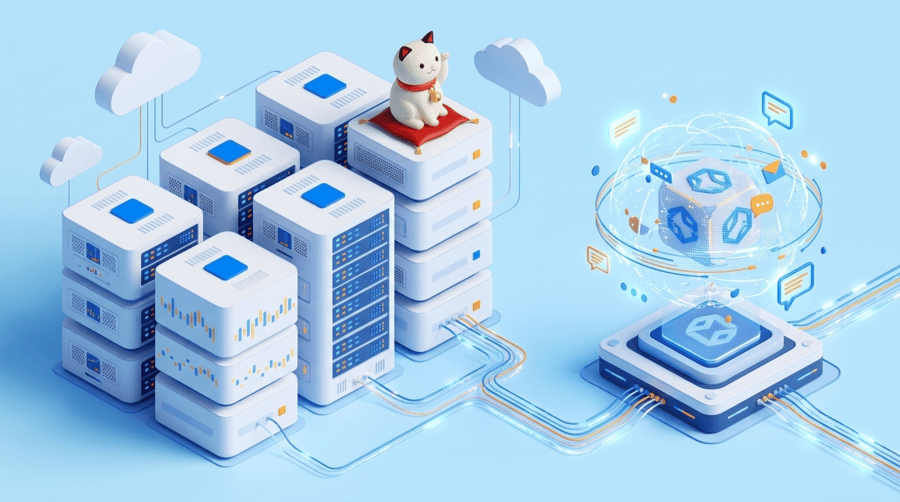
Supporting Messaging Based AI Agents with Optimized Server Infrastructure
A messaging agent can work well in testing, then become inconsistent once it starts handling live conversations all day. Replies slow down, retrieval feels uneven, tool calls queue up, and conversation context becomes harder to maintain. In many cases, the model is not the main issue. The weakness is the environment underneath it. For businesses running customer support agents, workflow assistants, or internal messaging automation, the real requirement is a server setup that stays responsive under steady activity.
That is why infrastructure matters so much. Messaging based AI agents rely on more than inference alone. They depend on retrieval, session memory, queue workers, logs, APIs, and background processes running together without friction. If the server cannot support that full stack, the chat experience starts to feel unreliable.
Why messaging based AI agents need more than standard hosting
A messaging AI system usually handles several tasks at once. It may manage context, retrieve knowledge, call tools, update memory, process webhooks, and route work between different services or agents. In multi-agent setups, the load increases further because each specialist agent may handle a separate role such as classification, resolution, or escalation.
This is why server infrastructure for AI agents should be planned around the whole runtime, not just the model layer. A chat interface may look simple to the user, but the backend is often coordinating orchestration, storage, retrieval, and messaging in real time. Standard hosting can struggle once usage becomes continuous.
This is also why many teams find that a server which feels fine during setup starts becoming unreliable under real traffic. Messaging systems create continuous read and write activity. They keep session state active, process event-driven tasks, and make repeated outbound calls to knowledge sources, APIs, and business systems. When all of that happens at once, the difference between basic hosting and a properly built environment becomes much more obvious.
CPU, RAM, storage, and network shape the real experience
For many deployments, the first performance requirement is not a GPU. It is stable CPU power, enough RAM, fast storage, and dependable routing. CPU supports orchestration, background tasks, and API handling. RAM supports vector indexes, live sessions, logs, and connected services. NVMe storage helps with embeddings, caches, and persistent history. If any of these become tight, the agent starts feeling slow or inconsistent.
Network quality also matters more than many teams expect. Messaging systems depend on stable access to external APIs, dashboards, databases, and business tools. Poor routing can make the whole experience feel laggy even when the hardware itself is fine.
For teams serving users across Hong Kong, Mainland China, or wider Asia, this becomes even more important. Dataplugs is relevant here because its dedicated server infrastructure includes Hong Kong, Tokyo, and Los Angeles locations, supported by BGP network design and CN2-optimized connectivity options for better regional performance.
In practice, messaging AI infrastructure is judged by consistency more than peak speed. A fast reply every now and then is not enough. The environment has to stay stable across thousands of interactions, repeated retrieval cycles, and overlapping requests. That is why balanced hardware and route quality usually matter more than headline specifications alone.
Why dedicated servers are often the better fit
Once messaging based AI agents move into production, dedicated hosting often becomes the more practical option. A dedicated server gives the workload cleaner access to CPU, memory, and storage without competing with shared tenants. That creates a more predictable environment for retrieval, queue workers, browser automation, and continuous conversation handling.
It also helps with operational control. AI agents may access internal systems, customer data, product information, or workflow tools. A dedicated environment gives businesses a cleaner boundary for access control, logs, firewall rules, and backup planning. Dataplugs fits well here because its dedicated server offerings can be paired with Anti-DDoS Protection, firewall services, WAF, and scalable hardware options suited to business workloads.
Another advantage is upgrade flexibility. AI workloads rarely stay small once they prove useful. More agents get added, more departments begin using them, and more integrations are introduced over time. A dedicated server setup makes it easier to scale deliberately instead of rebuilding the environment too early.
Where a Mac Mini setup can make sense
Not every AI agent deployment needs a large custom environment from day one. In some cases, a Mac-based setup can be a practical fit, especially when the workflow depends on MacOS tools, development pipelines, testing environments, or Apple-focused operations. If the messaging agent relies mainly on orchestration, integrations, and external model APIs rather than local heavyweight inference, a Mac Mini dedicated server can be a sensible option.
Dataplugs offers MacOS dedicated server hosting with genuine Mac hardware, including Mac Mini options that give businesses root access, dedicated resources, unmetered traffic, and the flexibility to run MacOS-based workflows in a data center environment. For certain teams, that can be useful for agent-related automation tied to Xcode development, Jenkins continuous integration, software testing, file services, or internal business workflows that need to stay within a Mac ecosystem.
A practical starting point for most deployments
For many production messaging AI workloads, a practical starting point is a modern enterprise CPU, 32GB to 64GB RAM, and 1TB to 2TB NVMe storage on a properly routed dedicated server. That is usually enough for orchestration, retrieval, background processing, and live messaging without overcommitting too early. If the workload later shifts toward self-hosted inference or heavier private AI use, the environment can then be expanded more deliberately.
This kind of setup gives enough room for the supporting layers that messaging based AI agents depend on every day. That includes queue workers, embeddings, logs, vector search, browser-based tasks, session history, and system monitoring. Many businesses underestimate how quickly these supporting services consume resources once usage becomes steady.
Dataplugs is a sensible option for this kind of growth because it offers dedicated servers by region and workload type, including Hong Kong dedicated servers, Tokyo dedicated servers, Los Angeles dedicated servers, AMD dedicated servers, GPU servers, all-flash NVMe server options, and MacOS dedicated servers for teams with more specific platform needs.
Conclusion
Supporting Messaging Based AI Agents with Optimized Server Infrastructure is really about keeping the full environment stable once the system starts doing real work. For most deployments, that means enough CPU for orchestration, enough RAM for connected services, fast NVMe storage for active data, and network quality that matches where users and systems actually are.
A dedicated server is often the practical next step when reliability, control, and consistent performance matter more than the lowest possible entry cost. For businesses deploying AI messaging systems across Asia, Dataplugs provides a strong infrastructure base through dedicated hosting, regional connectivity, and practical security services that support production use without making infrastructure the entire project.
To learn more about Dataplugs dedicated server hosting, contact the team via live chat or email at sales@dataplugs.com.