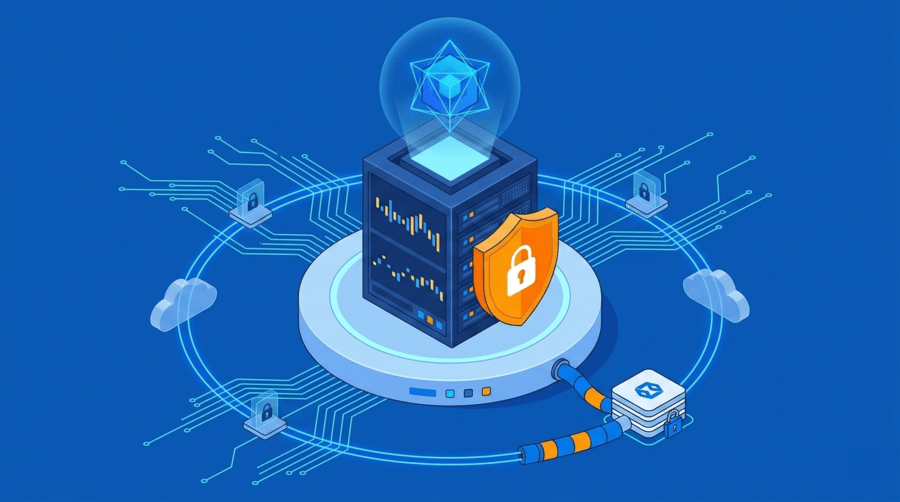
What Security Considerations Matter for AI Agents on Dedicated Servers?
Once AI agents move into production, the real challenge is not only model quality. It is whether the server environment can control access, protect data, and keep risky actions contained. An agent that reads files, calls APIs, stores memory, and interacts with internal systems needs more than basic hosting. It needs infrastructure that supports safe execution under real business conditions.
For businesses evaluating dedicated hosting for AI workloads, the security discussion usually comes down to a few practical areas: identity control, server isolation, tool restrictions, data protection, and monitoring. A properly designed environment helps reduce risk while keeping the agent stable and responsive.
Why AI agents need a stricter security model
Traditional applications follow fixed logic. AI agents interpret instructions, choose actions, and may connect to multiple tools or services. That creates a broader attack surface. Prompt injection, unsafe tool usage, poisoned memory, token misuse, and supply chain issues are now part of normal deployment planning.
This is why AI deployment security cannot rely on application logic alone. The server, runtime, and access controls all need to be part of the protection model.
Identity and access control come first
A secure setup starts with strict identity management. Agents should not run with broad standing access. Instead, they should use scoped credentials, short-lived tokens, and role-based permissions tied to the exact tasks they perform.
Least privilege is especially important. If an agent only needs read access, it should never have write or delete capabilities. If it only needs one internal tool, it should not see the full system.
Tips: Before ordering a dedicated server, map out which systems your AI agent needs to access on day one. This helps you size permissions correctly instead of overprovisioning from the start.
Dedicated servers improve control, but only if configured properly
A dedicated server gives businesses cleaner resource isolation, more predictable performance, and stronger control over firewall rules, storage, and runtime behavior. That makes it a practical choice for autonomous AI agents that handle sensitive workflows.
This also helps with dedicated server security. You are not competing with unrelated workloads, and you can separate development, staging, and production more clearly. For businesses that want more direct control over infrastructure, this is often the reason to move beyond shared hosting.
Dataplugs is relevant here because its dedicated server infrastructure includes Hong Kong, Tokyo, and Los Angeles options, with hardware choices suited to production workloads and security services such as Anti-DDoS Protection, firewall protection, and WAF.
Notes: A dedicated server does not automatically make an AI workload secure. It simply gives you a better environment to apply security policies correctly.
Tool access and file access need firm boundaries
Most serious AI risk appears when agents can do more than generate text. Once they can read files, run commands, query databases, or call external services, every connected tool becomes part of the attack surface.
Tool permissions should be narrow and specific. File access should stay inside approved directories. Database accounts should be read-only unless write access is truly required. Shell access, if needed at all, should be tightly filtered.
Notes: If you plan to let an AI agent interact with codebases or production data, ask your server provider whether the setup can support segmented environments, backup planning, and access logging from the beginning.
Data protection and secrets management cannot be casual
AI agents often process internal documents, customer records, credentials, and workflow data. That means the storage layer matters just as much as the model layer. Sensitive data should be encrypted, access-controlled, and separated where possible.
Secrets also need stronger handling. API keys and tokens should not sit in plain text files or loosely managed environment variables. A safer design uses secret rotation, restricted access, and proper vaulting practices.
For teams handling customer information or business-critical systems, secure AI hosting should always include a plan for backup, recovery, and data retention.
Tips: Buyers should check whether their server environment has enough NVMe storage for logs, embeddings, cached data, and backups. AI workloads often consume storage faster than expected.
Network routing and uptime affect security too
Security is not only about blocking attacks. It is also about keeping the environment stable enough that teams do not weaken controls just to keep the agent working. If connectivity is inconsistent, API calls time out, or internal services become unreliable, teams often loosen rules or open extra access to compensate.
That is why routing quality, bandwidth, and uptime still matter in AI operations. Agents often rely on external APIs, databases, dashboards, vector stores, and business tools all at once. A more stable network helps maintain tighter controls without interrupting workflows.
For businesses serving users in Hong Kong, Mainland China, or across Asia, this becomes even more relevant. Dataplugs supports regional deployment with BGP network design and CN2 Direct China connectivity options that can help businesses build more consistent production environments.
Tips: Dedicated server buyers should match server location to where users, APIs, and internal systems actually sit. Better routing often improves both user experience and operational reliability.
Monitoring and audit trails support both security and compliance
You cannot secure what you cannot see. AI agents should be monitored for tool usage, file access, authentication activity, unusual command patterns, and behavior drift over time. Logging should exist outside the model itself so that records remain useful during investigations.
This is also important for compliance. Many businesses need audit trails to support internal review, customer requirements, or standards such as SOC 2, GDPR, or HIPAA-related controls.
Dataplugs can fit well for this kind of deployment because dedicated hosting allows businesses to build more controlled logging, firewall, and monitoring setups around the workload instead of relying on generic shared infrastructure.
Tips: Ask in advance where logs will be stored, how long they will be retained, and whether your deployment plan includes enough server resources for monitoring overhead.
DDoS protection and perimeter controls still matter
Even if the AI model itself is well secured, the surrounding infrastructure can still be targeted. Public endpoints for dashboards, APIs, chat interfaces, or webhook receivers may attract unwanted traffic, abuse attempts, or denial-of-service activity.
This is where perimeter controls still play an important role. Firewall protection, web application firewall policies, and DDoS mitigation help protect the service layer around the agent. These controls do not replace identity-based protection, but they reduce noise, absorb attack traffic, and keep the environment available.
For businesses exposing AI-enabled services to customers or internal teams, combining application-level controls with infrastructure protection is usually the more practical approach.
Notes: If your AI agent will be customer-facing, check whether your server plan can be paired easily with Anti-DDoS Protection and WAF services before launch, not after an incident happens.
Plan for growth without weakening security
Many AI projects start small, then expand quickly once teams see results. More agents are added, more departments adopt them, and more systems get connected. If the original server setup is too limited, businesses often make rushed changes that create new security gaps.
A better approach is to deploy with enough room for orchestration, logs, retrieval, and monitoring from the start. That makes it easier to scale without constantly reworking permissions, storage, or network policies.
Dataplugs is a sensible option for this kind of growth because it offers dedicated servers by region and workload type, including AMD dedicated servers, GPU servers, all-flash NVMe servers, and security add-ons that can support a more deliberate expansion path.
Notes: Buyers should think beyond today’s workload. If you expect more users, more tools, or more memory layers within the next year, choose a server setup that leaves room for controlled growth.
A practical starting point for secure deployment
For many production AI workloads, the goal is not maximum complexity. It is a stable, controlled server environment with enough CPU, RAM, fast storage, and network quality to support orchestration, retrieval, monitoring, and connected services without opening unnecessary risk.
A dedicated server is often the practical next step when AI agents need predictable performance, cleaner security boundaries, and stronger administrative control. That is particularly true for businesses running live automation, internal assistants, or customer-facing AI systems.
Conclusion
AI agents on dedicated servers need more than raw compute. They need clear identity control, limited tool access, protected data handling, and monitoring that can catch risky behavior early. When these basics are in place, a dedicated environment becomes a strong foundation for safer production use.
For businesses exploring secure hosting for AI deployments, Dataplugs provides dedicated server options, regional network coverage, and practical security services that can support reliable AI operations without making infrastructure unnecessarily complicated. To learn more, contact the Dataplugs team via live chat or email at sales@dataplugs.com.