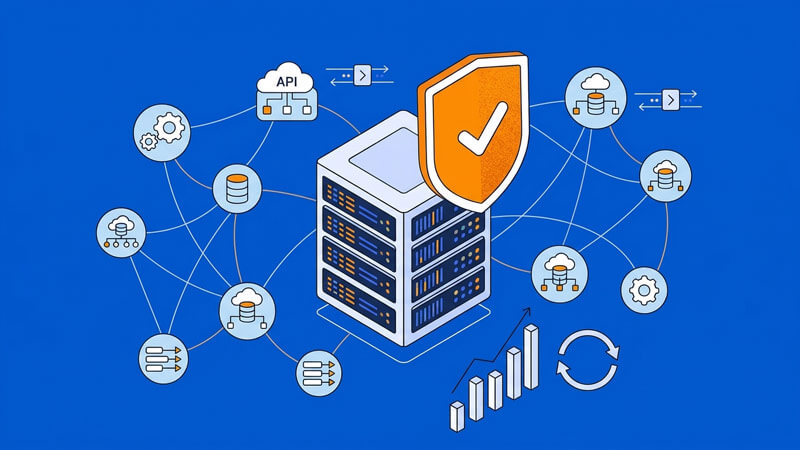
Why do dedicated servers still matter in an API-driven digital economy?
APIs connect the digital economy. SaaS platforms, payment services, logistics tools, and internal systems can process thousands of requests each minute, so infrastructure still shapes the user experience.
Public cloud remains useful for experiments, bursts, and managed services. Dedicated servers still deserve comparison when API workloads are steady, latency-sensitive, database-heavy, regulated, or costly to run on variable consumption pricing.
What an API-driven economy demands from hosting
An API request may cross a load balancer, application process, cache, queue, database, storage layer, and external integration. Teams should therefore watch p95/p99 latency, errors, retries, queues, storage wait, CPU pressure, and bandwidth.
- Early demand can be unpredictable, making elastic cloud capacity practical while a product is still changing.
- When traffic settles into a baseline, reserving known CPU, memory, storage, and network capacity can be easier to plan than paying for many variable services.
Compare the complete request path, data location, integration reliability, and monthly cost—not a single compute price or benchmark.
Tip: Compare the complete request path and the full monthly bill, not a single benchmark or an hourly compute price.
Dedicated servers solve the consistency problem
Shared and virtualised environments add layers between applications and physical resources. Scheduling, shared storage, virtual network paths, and provider limits may surface during busy periods as tail-latency spikes, retries, and timeouts.
- Dedicated hardware provides a known allocation of CPU, memory, storage, and network interfaces. Local SSD or NVMe can reduce storage variability, while administrative access allows tuning around the application.
- This consistency helps API gateways, payment services, developer platforms, and integration-heavy SaaS products. It also makes p99 investigations more focused.
A known physical baseline clarifies capacity planning: add a server or separate a database when measurements justify it.
API reliability depends on predictable tail latency
Dedicated servers are not for every API component, but can give production services reserved resources and predictable I/O. Dataplugs’ why dedicated servers outperform public cloud for scaling SaaS platforms explains the SaaS trade-offs.
- Average response time can hide a small group of slow requests. Stable CPU scheduling, storage queues, and network throughput help keep p95 and p99 behaviour within a narrower range.
- Local NVMe is useful for transaction logs, indexes, queues, and cache files. It cannot fix poor queries, but it can remove one source of waiting.
Network quality matters too. Route quality, jitter, packet loss, connection limits, and server location can matter more than headline bandwidth.
Cost predictability can shape the business model
Public-cloud bills may combine instance time, databases, storage, I/O, snapshots, load balancers, public IPv4, support, and outbound transfer. More meters can make a successful API product harder to forecast.
Workload costs vary by sector. Dataplugs’ dedicated server infrastructure for different industries explains why infrastructure should follow workload.
- Fixed monthly dedicated-server pricing does not remove monitoring, but it makes the baseline easier to budget and capacity planning easier to explain.
- Include migration, backups, security, monitoring, support, staff time, transfer rules, and outage impact when comparing total cost.
A dedicated server can sit between a small virtual instance and a complex distributed platform, with expansion driven by evidence.
Tip: Treat predictable monthly capacity as a planning tool, not as an excuse to stop measuring performance.
Control and isolation remain relevant
API services move data through requests, logs, caches, files, and backups. Single-tenant hardware narrows the physical trust boundary and gives teams clearer control over where workloads run.
- Root access helps when teams need a particular Linux distribution, database version, firewall policy, reverse proxy, container runtime, or monitoring agent.
- Isolation is not security. Patching, strong authentication, least privilege, segmentation, secret management, encrypted backups, and incident response remain necessary.
Location affects latency, contracts, and support. Dataplugs offers deployments in Hong Kong, Tokyo, and Los Angeles; choose from user distribution, dependencies, recovery, and data requirements.
Dedicated servers fit more than one type of workload
They suit SaaS platforms with steady API traffic, active databases, background workers, and predictable resource needs. They can also fit e-commerce, fintech, media, gaming, and real-time applications.
- Industry changes the balance: media may need throughput, fintech may need isolation, and software platforms may need multi-core capacity and deployment freedom.
- Not every API needs dedicated hardware. Small, short-lived, or highly bursty workloads may benefit from elastic cloud capacity. Reassess as traffic, data, or compliance changes.
Dataplugs offers selected Intel or AMD processors, NVMe storage, higher-bandwidth configurations, and regional deployments. Confirm availability, support, network terms, and upgrade paths.
ERP, integrations, and internal systems still need a stable base
The API economy includes ERP, CRM, warehouse, HR, finance, manufacturing, and reporting systems. A delayed integration can hold up orders, approvals, inventory, or reporting even when a public website is healthy.
- ERP workloads combine concurrent users, transaction logs, reports, scheduled jobs, and external connections. Reserved resources and NVMe make the environment easier to baseline.
- Configuration freedom also matters. Full control helps teams install middleware, security agents, backup software, and network rules without guessing which shared layer changed.
A dedicated server does not create redundancy by itself. Define backups, recovery objectives, monitoring, maintenance, access, and a second recovery method where justified.
Hybrid architecture does not make dedicated servers obsolete
A hybrid model can keep burst capacity, development environments, object storage, or specialist services in public cloud while core APIs and databases use dedicated servers. Make the boundary and responsibilities explicit.
- Use cloud elasticity where it creates value; use dedicated resources where consistency, data control, or cost visibility matters more. Secure the connection and document failure handling.
- Hybrid architecture adds operational work. Monitor both environments, control identity, test data movement, and assign ownership for each failure mode.
For enterprise systems, Dataplugs’ guide on how dedicated servers support enterprise ERP systems outlines stable database, access, integration, and growth needs.
Measure the decision with evidence
Start with a production or staging baseline: request volume, p50/p95/p99 latency, errors, retries, CPU, memory, database wait, disk latency, queues, network throughput, and monthly cost.
- Run a controlled comparison with the same code, indexes, payloads, cache policy, and monitoring. Test sustained concurrency, background jobs, recovery, backups, deployment, and regional access.
- Set thresholds before testing, such as a p99 target, maximum cost variance, recovery time, or security boundary. Apply the same standard to dedicated and cloud options.
Review after major product changes. Traffic, frameworks, database size, user geography, and pricing evolve, so the baseline needs maintenance.
Tip: Decide what must be predictable first, then choose the infrastructure that makes that outcome easiest to measure and maintain.
Make the decision workload-first
Ask four questions: how steady is the workload, where is the bottleneck, how much control does the data require, and how predictable must monthly cost be?
No model wins every API workload. Dedicated servers remain relevant when reserved resources, stable performance, administrative freedom, regional placement, and clearer economics matter more than maximum short-term elasticity.
Conclusion
Dedicated servers still matter because not every API workload is bursty, stateless, or cheap to meter. SaaS, ERP, enterprise integrations, data-heavy APIs, and regional services often benefit from a predictable physical base.
Dataplugs’ dedicated infrastructure can be evaluated against performance, security, support, location, and growth requirements. Start with measurements, compare the full operating cost, and choose the model that fits the workload.
For more information, visit the Dataplugs website or contact sales@dataplugs.com.